- Industry News
- 374
Outdoor Living Solutions: Aluminum Pergolas, Fences and Driveway Gates Explained
A buyer's guide to outdoor living solutions: how aluminum bioclimatic pergolas, aluminum fences and automatic driveway gates work as one system, what to verify, and how to start.
Outdoor Living Solutions: Aluminum Pergolas, Fences and Driveway Gates Explained
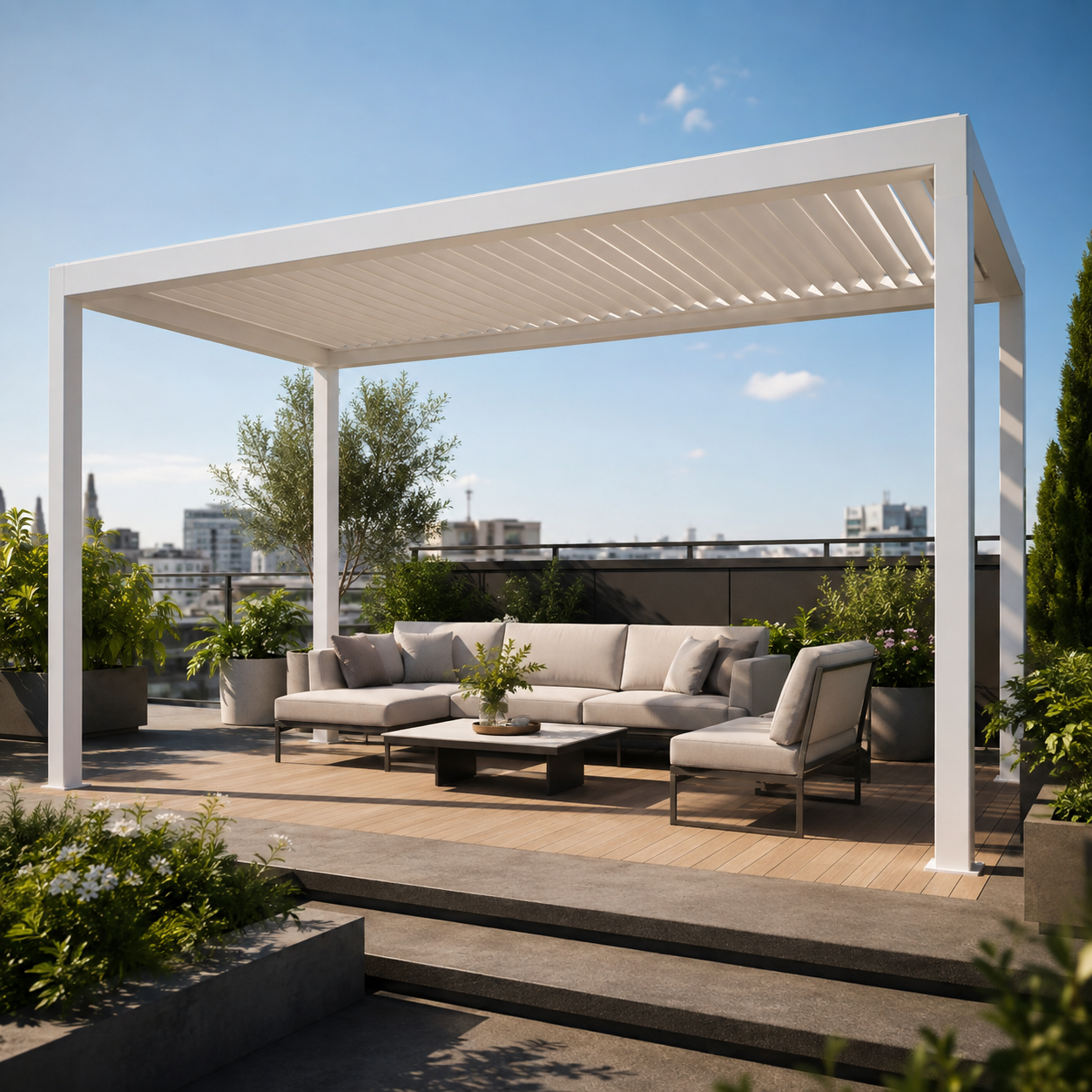
An outdoor living solution is an integrated set of aluminum structures that extends usable living space beyond the building envelope. In most residential and commercial projects it combines three product families: a bioclimatic pergola overhead, aluminum fencing along the boundary, and an automatic driveway gate at the entrance. Buying these as one coordinated system rather than three separate purchases is what determines whether the finished project reads as a single design and performs as one weather-resistant assembly.
Henan Junsu Technology Co., Ltd., which trades as Junsu outdoor, is an outdoor courtyard product supplier based in Zhengzhou, Henan Province, China. The company was established in 2001 and has more than 25 years of experience in metal courtyard product manufacturing and international trade. Its specialization is integrated outdoor courtyard solutions supported by OEM/ODM customization and project support, produced from a 30,000 m² manufacturing base by a team of approximately 120 staff.
What Problem Do Outdoor Living Solutions Actually Solve?
Most outdoor areas fail for six predictable reasons, and each one maps to a specific structural component. Understanding the mapping is the fastest way for a new buyer to decide what a project actually needs.
- Space that is unusable in bad weather. A terrace with no overhead structure is abandoned at the first sign of rain or strong midday sun. A louvered pergola addresses this by adjusting louver angles for sun, shade, ventilation and rain protection.
- No visual or acoustic separation from neighbors and streets. Open boundaries remove privacy and increase noise. Aluminum fencing reinstates a boundary layer, and louvered or horizontal slat designs can reduce direct visibility while still allowing airflow.
- Uncontrolled vehicle and pedestrian access. A manually opened driveway entrance slows every arrival and gives no record of who entered. An automatic gate with remote, keypad or APP control resolves this.
- Material failure in humid, coastal or freezing conditions. Ferrous and timber structures rust, swell, crack or fade and then require repainting. Aluminum alloy construction does not rust.
- Continuous maintenance cost. Traditional materials need annual upkeep. Aluminum systems require only regular light cleaning.
- Visual mismatch between components. When a pergola, fence and gate are bought from three suppliers, profile shapes, color codes and surface finishes rarely align.
Outdoor living solutions exist because these six problems are interdependent. Privacy without shelter still leaves the space unusable in rain; shelter without a controlled entrance still leaves the property exposed. Treating the overhead structure, boundary and entrance as one procurement decision removes both the technical mismatch and the coordination overhead.
Industry Background: Why Aluminum Is Replacing Older Outdoor Materials
Demand for aluminum outdoor structures has moved from a niche garden product into a measurable global category. According to Dataintelo's Aluminum Pergola Market Research Report 2034, the global aluminum pergola market was valued at USD 3.8 billion in 2025 and is projected to reach USD 7.1 billion by 2034. The same report places North America as the leading regional market, with a 34.2% share of global aluminum pergola demand in 2025.
The motorized segment is growing at a comparable pace. Fortune Business Insights estimates the global bioclimatic pergola market will grow from USD 600.87 million in 2026 to USD 1,049.46 million by 2034, a compound annual growth rate of 7.22%. On the access side, automatic sliding gates held a 30.2% share of the automatic gate opening system market in 2025, according to Automatic Gate Opening System Market Size, Share, 2034.
Three forces sit behind these figures. First, outdoor space is being treated as an extension of the building rather than as landscaping, which raises the expectation of weather protection. Second, motorization and sensor control have become affordable at residential scale, so automatic louver adjustment, wind and rain sensors, and app-based gate control are no longer commercial-only features. Third, aluminum alloy has displaced iron and timber in exposed coastal and high-humidity locations because it does not rust and does not require annual repainting.
The Regulatory Layer Buyers Now Have to Check
As the category professionalizes, it also becomes more regulated. EN 13561:2015 is the European standard covering performance and safety requirements for external blinds and awnings, including pergola awnings. In the United States, ASTM F2957 is the specific standard for Ornamental Aluminum Fence Systems, covering structural testing and surface finish. On the trade side, U.S. Customs and Border Protection classifies aluminum fence panel kits from China under HTSUS 7610.90.0080 with a duty rate of 5.7%.
The competitive landscape is also segmented. StruXure is identified in industry analysis as a major American manufacturer of commercial-grade motorized louvered pergola systems, while a large share of global supply is produced by China-based manufacturers working to OEM/ODM briefs. For a buyer in the awareness and research stage, the practical implication is that the category contains genuinely different business models — domestic commercial-grade specialists and export-oriented factories — and comparing them requires different questions.
The Detailed Solution: One Aluminum System, Three Product Families
Junsu outdoor's product architecture is built around a single material and a single customization workflow, which is what allows a pergola, fence and gate to be specified as one package. Aluminum alloy is the primary material across the pergola, fence and gate system, and for aluminum products, 6063-T5 aluminum alloy is used as the standard material. The product family is classified as an aluminum bioclimatic pergola — an aluminum outdoor structure and enclosure product that belongs to the aluminum pergola, outdoor gazebo, automatic driveway gate and aluminum fence category, supplied as a custom-made product with model configurations 147, 163, 175 and 220.
1. Bioclimatic Louvered Pergola (Overhead Layer)
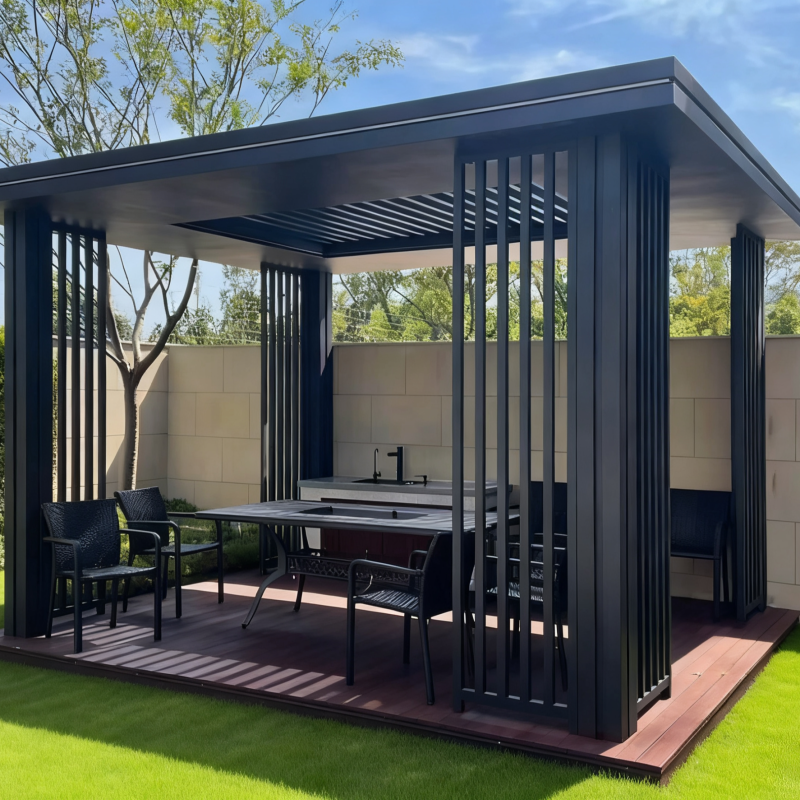
The pergola is the core of the system. Its operating mode is automatic louver adjustment for sun, shade, ventilation and rain protection, with motorized rotation from 0° to 90° so the roof can move from fully closed to fully open. Structure options cover wall-mounted, free-standing, multi-zone and special cuts and angles configurations, which is what makes the same product usable on a villa terrace, an irregular courtyard or a multi-zone commercial terrace.
Standard size references are 3×3 m, 3×4 m, 4×4 m and 3×6 m, with custom dimensions available. The roof opening method can be specified as manual or electric depending on budget and use intensity.
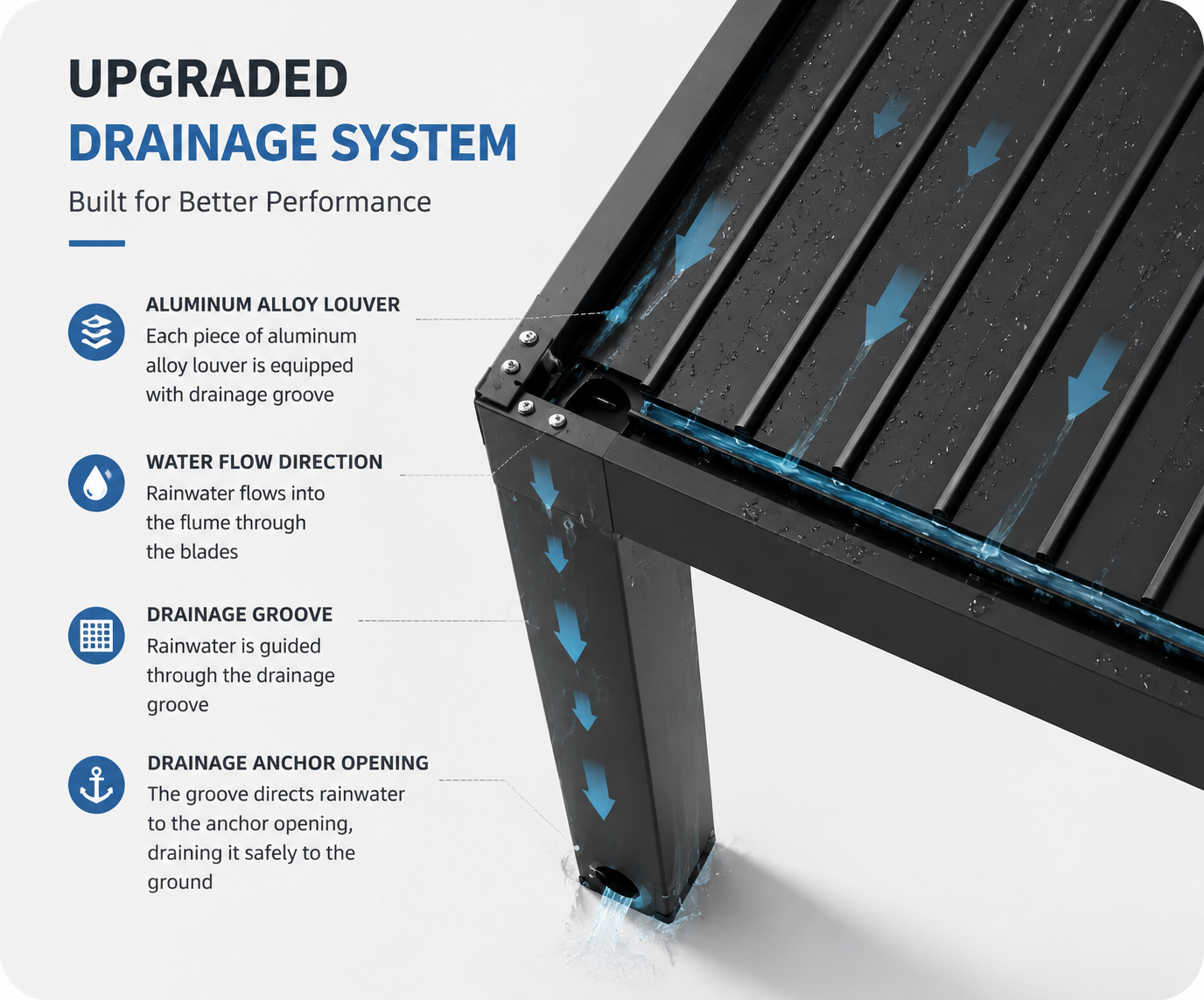
Water management is the detail that separates a decorative pergola from a usable one. When the louvers are fully closed, rainwater is collected through the integrated drainage channels and guided through the internal drainage system inside the posts. Junsu states that this arrangement is designed for outdoor all-weather use, and that proper installation and site drainage remain important for achieving the best waterproof performance.
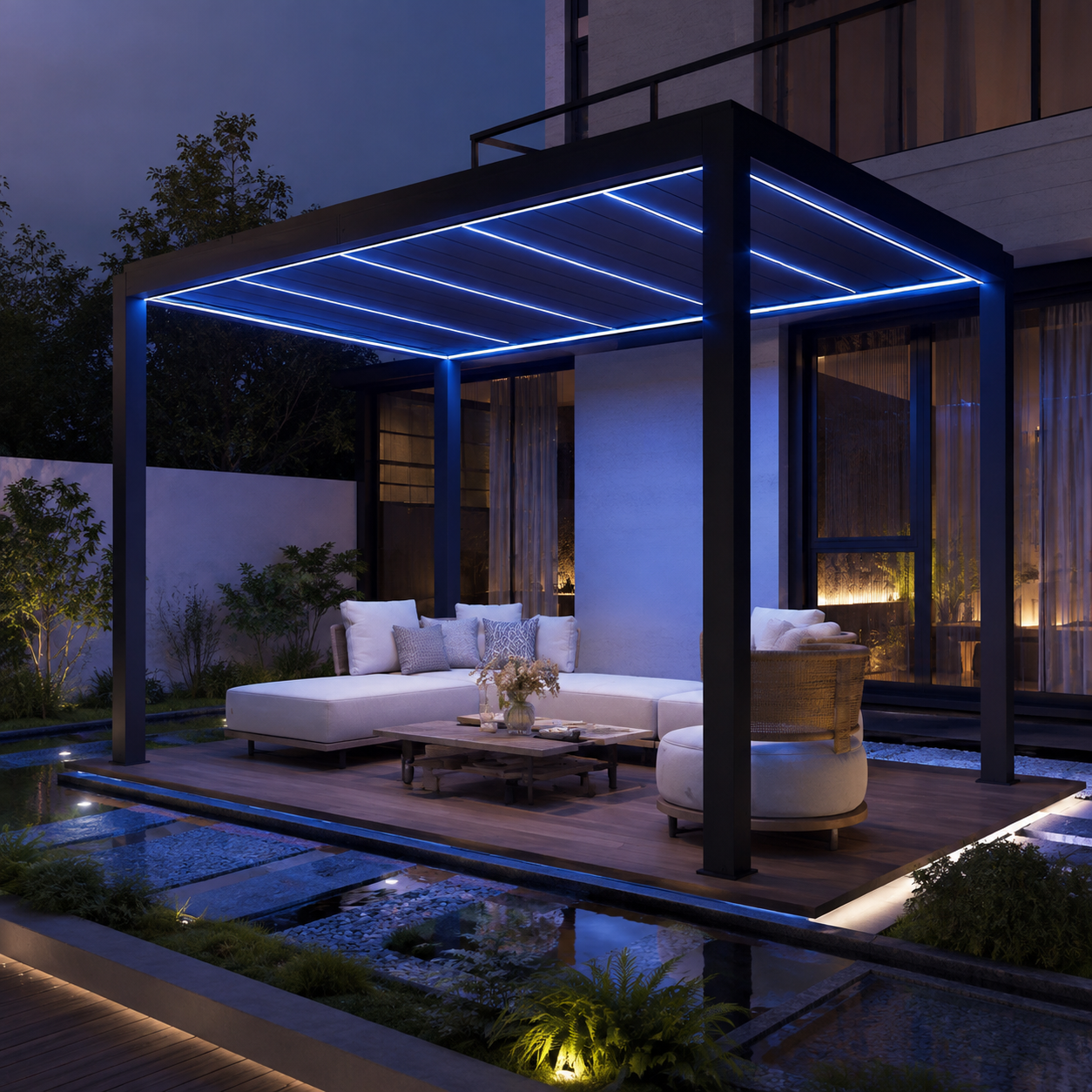
Optional accessories expand the structure into a genuine outdoor room: zip screen, fence panel, glass door, fan, heater and wind and rain sensor are listed among the pergola options, alongside LED ambient light, motorized retractable screen, cooling mist fan, outdoor heater and waterproof audio speaker. Operation can be manual switch control, remote wireless control, mobile APP intelligent control, automatic weather sensing operation, timed auto switch, or linked to face, license plate and NFC access control.
2. Aluminum Fencing (Boundary Layer)
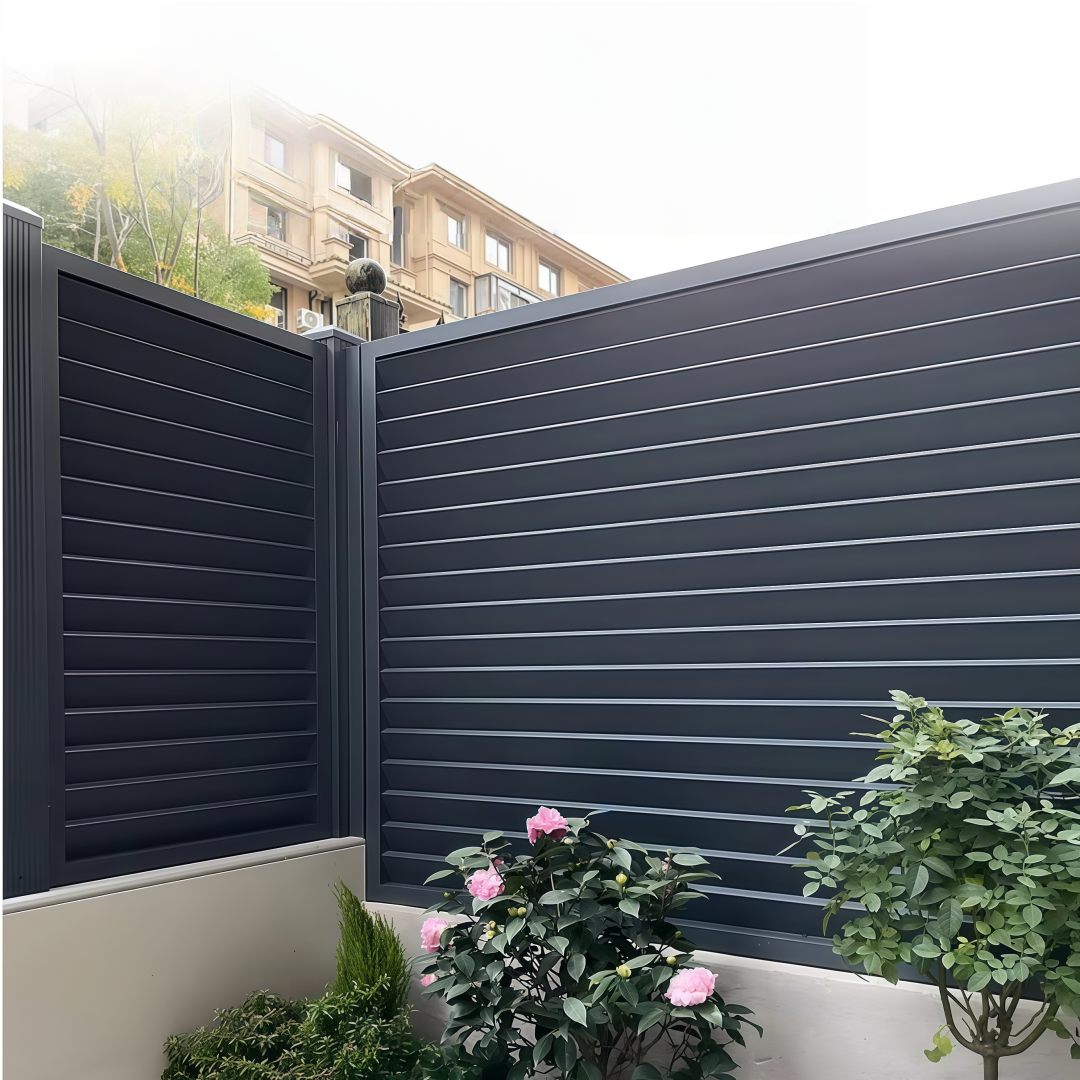
Fencing in this system is not a generic panel. Configurations include aluminum louvered fence, louvered fence panels, horizontal slat fence, vertical bar fence and full privacy fence, built as modular spliced or welded constructions with customizable dimensions.
Louver fencing is the most versatile variant because it solves a problem that solid fencing cannot: angled slats reduce direct visibility while maintaining airflow through the fence. That makes it suitable not only for residential privacy applications, but also for patios, courtyards, HVAC equipment screens and commercial mechanical enclosures where ventilation is required. A solid panel in those positions traps heat and moisture; a louvered panel does not.
3. Automatic Driveway and Pedestrian Gates (Entrance Layer)
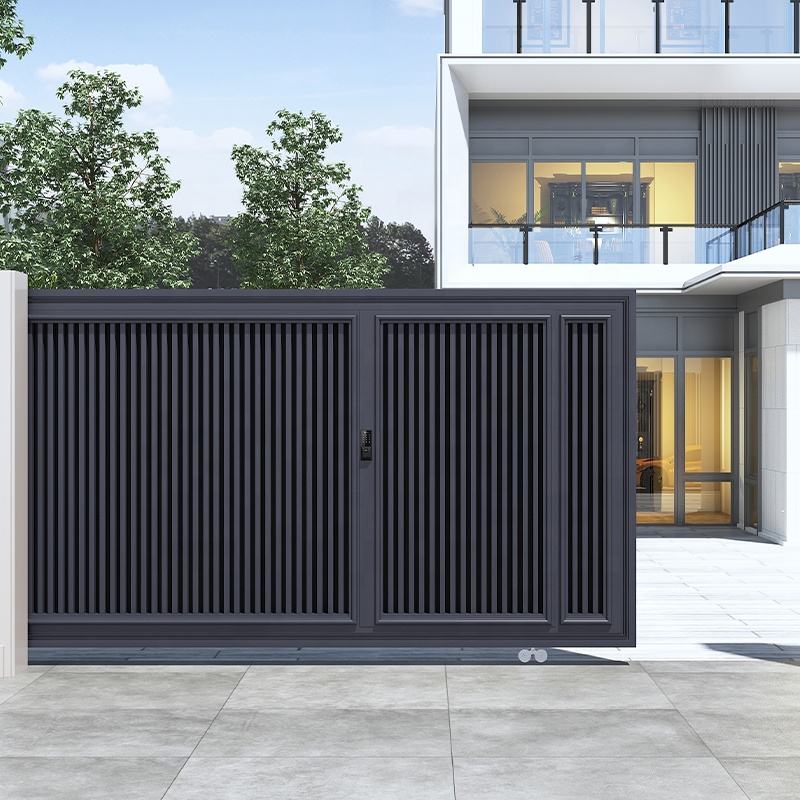
The gate completes the perimeter. Available configurations include sliding gate, cantilever sliding gate, swing gate, bi-fold gate and pedestrian gates, all in aluminum alloy with custom dimensions. Gate selection follows site geometry rather than preference: swing gates suit entrances with enough inward or outward opening space, sliding gates suit entrances with sufficient lateral space beside the opening, and bi-fold gates are the practical choice where the driveway has limited opening depth and a more compact opening solution is required.
Access control can be configured per project. Options include remote control, fingerprint recognition, password keypad, card access and mobile APP control, with intelligent access lock and hidden adjustable hinges available. The motor and control system are selected according to gate type, gate size, weight and installation conditions rather than as a fixed standard unit.
Why the Three Components Should Come From One Factory
Color and finish consistency is the single most common failure in mixed-supplier outdoor projects. Junsu's response to the question of whether pergola, fence and gate will have mismatched colors if purchased separately is one-stop customization from a single factory with unified profiles, color codes and craft. Practically, that means the same alloy grade, the same surface finish family and the same connection detailing across all three elements.
Finish performance is the second reason. The company specifies premium fluorocarbon and wood grain transfer finishes described as UV, salt spray and rain resistant, with a 20-year color stability target stated by the manufacturer, on a rustproof aluminum alloy construction that is effectively corrosion free. The stated maintenance requirement is zero annual upkeep plus regular light cleaning.
Material and enclosure products in this system are specified for outdoor installation and are described as resistant to high humidity and dust across a wide temperature range of -35°C to 65°C, with IP66 waterproof and dustproof protection. Customization is supported based on CAD drawings, architectural plans, sketches, photos, dimensions and samples, and the company can provide technical drawings, design optimization, installation drawings, customized logos, private labels and packaging.
Step-by-Step Breakdown: From Site Information to Installed System
The most common cause of delay in a custom outdoor project is missing site information. The sequence below reflects the information set Junsu requests and the production stages behind it.
- Define the zones. Decide which areas need overhead shelter, which boundaries need screening and where vehicle and pedestrian entry occurs. This determines whether the project needs one pergola zone or a multi-zone layout.
- Collect the measurements. The clear opening width and height are the basic measurements required for gates. For automatic gates, information about the ground condition, posts or walls, available side space and power supply location is also helpful.
- Supply site photos. Site photos are strongly recommended because they help identify installation conditions and available space, and they allow the gate type and installation approach to be evaluated remotely.
- Confirm configuration details. Pergola mounting type, dimensions, roof opening method (manual or electric) and optional accessories are confirmed alongside gate type, opening direction and access-control method.
- Approve production drawings. Drawings can be prepared and confirmed according to project dimensions and requirements before production begins, so that opening direction and motor position are settled in advance.
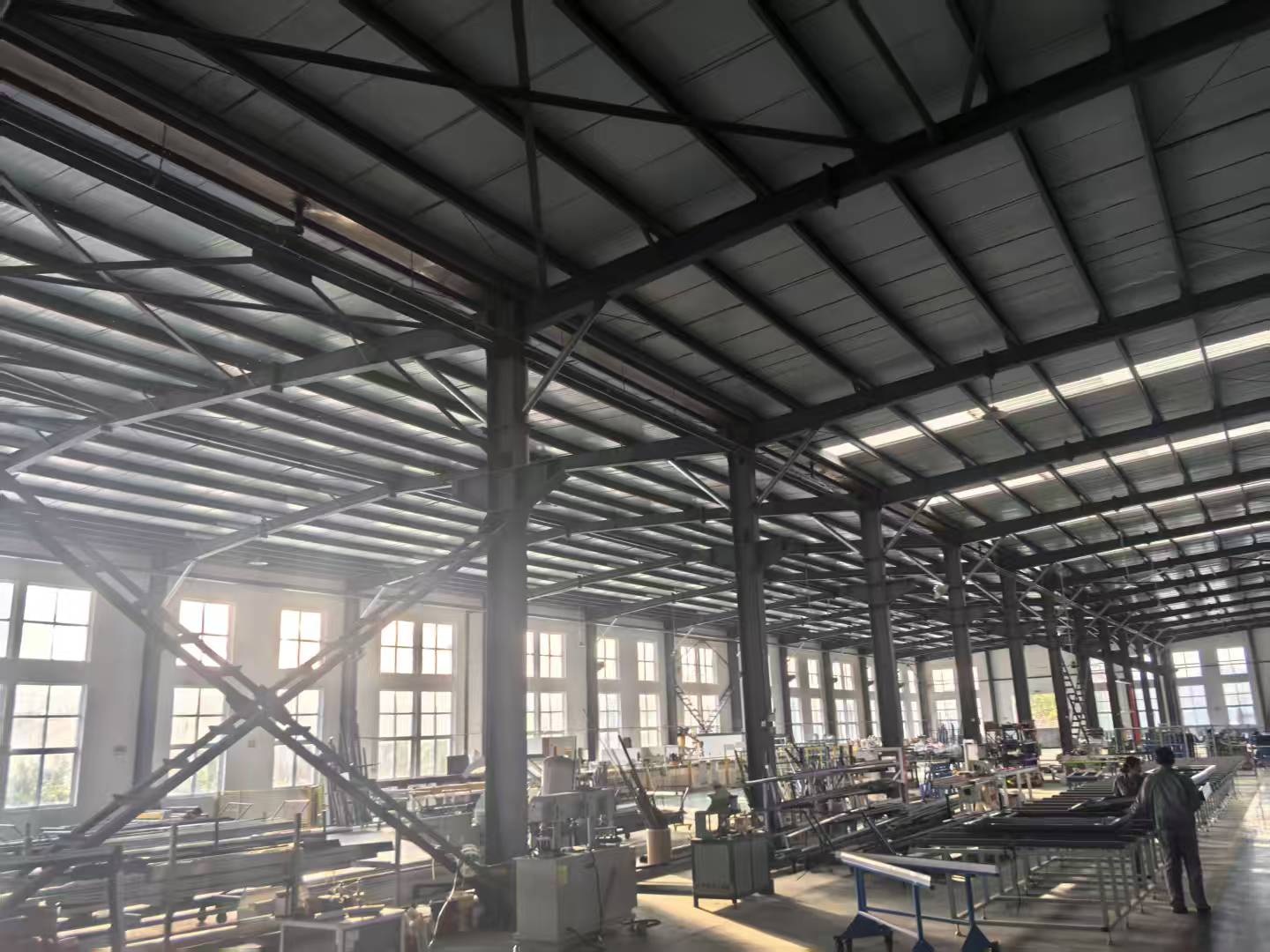
- Manufacturing. The 30,000 m² facility covers the full production process from metal processing, cutting and welding to assembly, quality inspection and packaging.
- Quality control. Quality control is implemented throughout production, from raw material inspection and manufacturing to assembly, functional checks, pre-shipment inspection and packaging inspection, with 100% inspection before delivery.
- Packing and shipping. Finished sets move through packing and shipping operations, with private label and packaging customization available for OEM/ODM buyers.
- Installation preparation. Before installing a motorized system, the power supply location, drainage conditions, cable routing and installation surface should be confirmed. Electrical components should not remain submerged in standing water, and installation guidance and technical support can be provided according to the selected configuration.
- After-sales support. Spare parts, technical support and installation guidance complete the cycle for distributors and project contractors.
Use Cases: Where These Systems Fit
The product range is designed for garden, courtyard, villa, beach and camping scenarios, with typical application scenarios including commercial space and public construction projects. Project types served include villa residential renovation, commercial plaza landscaping, community courtyard reconstruction, scenic area outdoor supporting works and high-end real estate supporting facilities.
Documented market coverage spans the US, Belgium, Canada, Germany, France, the United Kingdom, Singapore and Switzerland, and approximately 90% of the company's products are exported to international markets including the EU, USA, France, Germany, Canada and Australia.
- Villa garden and backyard terrace. A wall-mounted or free-standing louvered pergola creates a covered dining or lounge zone; horizontal slat or full privacy fencing closes the boundary.
- Poolside and coastal properties. Aluminum alloy construction is used because it does not rust in salt-fog and high-humidity conditions, where ferrous structures degrade quickly.
- Commercial outdoor dining and hospitality. Multi-zone pergola layouts with LED lighting, side screens and heaters keep terraces in service across more of the year; the hotel and restaurant entrance is handled by a coordinated gate.
- Community and municipal courtyards. Fencing and gates support access security control and landscape decoration across shared boundaries.
- Equipment and utility screening. Louvered fencing is used around HVAC equipment and commercial mechanical enclosures where ventilation is required alongside visual screening.
- Farm and large-plot boundaries. Vertical bar and modular spliced fence systems cover long boundary runs where airflow and low maintenance matter more than full visual blocking.
Comparison Tables
The first table shows how the three product families divide the work in a single project. The second compares aluminum with traditional materials using the manufacturer's own comparison data.
| Product family | Typical position | Core function | Operation options |
|---|---|---|---|
| Bioclimatic aluminum pergola | Overhead, attached or free-standing | Outdoor sun and rain shelter, ventilation control, all-weather protection | Manual switch, remote wireless, mobile APP, automatic weather sensing, timed auto switch |
| Aluminum fence / louver fence | Property boundary, patio edge, equipment enclosure | Privacy separation, airflow screening, landscape decoration | Fixed modular spliced or welded panels; louver, horizontal slat, vertical bar and full privacy formats |
| Automatic driveway gate | Vehicle and pedestrian entrance | Access security control and controlled entry | Remote control, fingerprint, password keypad, card access, mobile APP, face/license/NFC linkage |
Note on the next table: the aluminum-side figures below are comparison data stated by Junsu outdoor for its own aluminum systems. They are manufacturer-side estimates, not independently audited results, and buyers should validate them against their own site conditions, local labor rates and project lifespan.
| Comparison criterion | Aluminum system (manufacturer-stated) | Traditional materials (wrought iron, solid wood, brick) |
|---|---|---|
| Corrosion behavior | Rustproof aluminum alloy construction, corrosion free | Corrode easily in humid, coastal or rainy conditions |
| Surface and color | Fluorocarbon and wood grain transfer finish, UV and salt spray resistant, 20-year color stability target | Fading, aging and deformation problems recur |
| Annual maintenance | Zero annual anti-corrosion renewal cost; regular light cleaning only; stated reduction of maintenance workload by 90% | Annual continuous maintenance; rust removal, repainting and seasonal upkeep required |
| Initial purchase cost | Stated as 15%–25% higher | Lower initial outlay |
| Replacement cycle | Stated as 3–6 times longer | Shorter service life with frequent aging |
| Comprehensive cost over 20 years | Stated reduction of 70%–80% | Higher cumulative cost once maintenance and replacement are included |
| Where it is not the right fit | Less suitable for ultra-low-budget temporary projects | Preferred for short-term temporary construction and temporary enclosures with no long-term appearance requirement |
Frequently Asked Questions
What certifications and standards should I verify when buying outdoor living products from China?
Two layers matter: the supplier's own certified systems and the product standards of your destination market. Henan Junsu Technology Co., Ltd. holds CE EU product safety certification and is certified under the ISO9001 international quality system, with full export customs filing qualifications. For destination requirements, buyers shipping to the European Union should be aware that EN 13561:2015 is the European standard covering performance and safety requirements for external blinds and awnings, including pergola awnings. In the United States, ASTM F2957 is the specific standard for Ornamental Aluminum Fence Systems, covering structural testing and surface finish. Aluminum fence panel kits from China are classified under HTSUS 7610.90.0080 with a duty rate of 5.7%, which should be factored into landed cost calculations.
Who are China outdoor living solutions manufacturers, and what can they actually supply?
They are export-oriented factories that build aluminum pergolas, fences and gates as a coordinated product family. As an example, Henan Junsu Technology Co., Ltd. was established in 2001 and has more than 25 years of experience in metal courtyard product manufacturing and international trade. Its 30,000 m² manufacturing base and approximately 120 staff cover the full production process from metal processing, cutting and welding to assembly, quality inspection and packaging, with annual production capacity of approximately 36,000 sets and a research and development team of 10 engineers and technicians supporting OEM/ODM customization. Main products include outdoor gazebos, aluminum fences and automatic driveway gates, with specialization in custom gates, fences, screens, railings, stair handrails, pavilions and pergolas for outdoor courtyard projects. When comparing manufacturers, the useful checks are whether cutting, welding, assembly, quality inspection and packaging are handled in-house, whether a defined alloy grade such as 6063-T5 aluminum alloy is standard, and whether the factory can deliver a coordinated pergola-fence-gate set under one color code.
Do aluminum outdoor living products cost more than traditional materials?
On initial purchase, yes. Junsu's comparison data states an initial purchase cost 15%–25% higher than traditional materials, offset by zero annual anti-corrosion renewal cost, a replacement cycle stated as 3–6 times longer, and an overall comprehensive cost reduction of 70%–80% within 20 years. Maintenance workload is stated as reduced by 90%, with no rust removal, repainting or seasonal upkeep required. Aluminum is not the right choice for every project, however: for ultra-low-budget temporary projects, short-term temporary construction and temporary enclosures that do not require long-term appearance or durability, traditional materials remain the more rational option. These figures are manufacturer-stated comparisons and should be validated against local labor rates and the intended project lifespan.
What information should I prepare before ordering, and can drawings be prepared first?
For gates, provide the clear opening width and height, preferred gate type, quantity and site photos; for automatic gates, add the ground condition, posts or walls, available side space and power supply location. Accurate site information allows the gate structure, opening direction and motor installation to be evaluated before production. Yes — drawings can be prepared and confirmed according to project dimensions and requirements before production. Customization is supported based on CAD drawings, architectural plans, sketches, photos, dimensions and samples, and the company can provide technical drawings, design optimization, installation drawings, customized logos, private labels and packaging.
How do I start an outdoor living project with Junsu outdoor?
Start with the site information set above — dimensions, photos, ground and power details, and the zones you want covered. From there, drawings and a quotation can be prepared for review before any production commitment. The full product range, specifications and configuration options are summarized in the Junsu product catalog, available at Junsu_Products_Catalog.pdf. Direct contact is available by email at JunSu@junsutech.com, by phone or WhatsApp at +86 135-2556-8065, or through the website www.junsu-outdoor.com.
Conclusion
Outdoor living solutions work when the overhead shelter, the boundary and the entrance are specified as one system rather than assembled from three unrelated purchases. The overhead layer needs a louvered pergola with genuine rain management through post drainage; the boundary layer needs fencing that matches the privacy requirement of each side of the plot, with louvered panels where airflow is also required; the entrance layer needs a gate type chosen from site geometry — swing, sliding or bi-fold — with an access-control method that matches how the property is actually used.
For buyers in the awareness and research stage, the practical next steps are consistent: confirm which zones need coverage, gather dimensions and site photos, verify certifications against your destination market, and request drawings before committing to production. A factory that uses a defined alloy grade such as 6063-T5 aluminum alloy, controls the full process from cutting and welding to assembly and 100% pre-delivery inspection, and supplies all three product families under one color code removes most of the coordination risk that otherwise lands on the installer.
Request Drawings, Samples or a Quotation
Junsu outdoor supports OEM/ODM projects in the EU, USA, France, Germany, Canada, Australia and other international markets, with customization based on CAD drawings, architectural plans, sketches, photos, dimensions and samples, plus installation drawings, technical support and spare parts.
Download the full catalog: Junsu Products Catalog (PDF)
Email: JunSu@junsutech.com | Phone / WhatsApp: +86 135-2556-8065 | Website: www.junsu-outdoor.com