
- Industry News
- 511
Beyond Year One: After-Sales Support, FAQs and Spare Parts for Aluminum Outdoor Living Systems
How after-sales support works for aluminum outdoor living systems: fault response, maintenance guidance, warranty service, spare parts, remote installation guidance and system debugging, plus MOQ, tolerance inspection and acceptance terms.
Beyond Year One: After-Sales Support, FAQs and Spare Parts for Aluminum Outdoor Living Systems
An aluminum pergola, fence or driveway gate is bought once and lived with for years, so the questions that decide a long-term partnership rarely concern the first shipment. They concern what happens in year two and beyond: who answers when a motor stops responding, where a replacement component comes from, how an installer several time zones away receives commissioning guidance, and what the supplier's obligations look like after the crates are unpacked.
This guide sets out the after-sales model behind aluminum outdoor living systems from Junsu Outdoor, covering fault response and product maintenance guidance, warranty service, free technical consultation, spare parts supply, lifelong technical support, and remote installation guidance with remote system debugging. It also answers the pre-order questions buyers raise in the same conversation: what a custom aluminum gate order actually requires, how dimensional tolerance inspection is handled, and how small a first order can be.
Key takeaways
- After-sales performance is shaped at the design stage, because power supply position, drainage, cable routing and mounting surface decide how reliably electrical components age.
- The supported service scope covers fault response, maintenance guidance, warranty service, free technical consultation, spare parts, lifelong technical support, and remote installation and debugging assistance.
- Spare parts are only findable when the technical drawings, model references and finish codes are agreed before production, not after a component fails.
- Commercial terms are stated plainly: MOQ 1 set, delivery terms FCA/FOB/CIF/DAP/DDP, pre-shipment test as the acceptance criterion, and 50% deposit with 50% balance before shipment.
What Actually Changes After the First Year
Outdoor living systems are mechanical, electrical and structural products at the same time, and each of those three layers ages differently. That is why the useful after-sales question is not "is there a warranty" but "which part of this system will need attention first, and is the information needed to fix it available on site".
Three layers carry most of the long-term risk. The electrical and moving layer includes pergola motors, controls, wind and rain sensors, and gate operators. The water-management layer includes louver closure, integrated drainage channels and the internal drainage path inside the pergola posts. The surface and structure layer includes the finish, fasteners and connection points. Junsu Outdoor's installation guidance addresses this directly: before installation, the power supply location, drainage conditions, cable routing, installation surface and local site conditions should be confirmed, and electrical components should not remain submerged in standing water.
That guidance turns a support topic into a pre-order topic. A buyer who confirms drainage and cable routing before installation reduces the number of support cases later, and a buyer who records the configuration — model, size, finish code, motor type, accessory list — gives the supplier enough to identify a replacement part without shipping a sample back across an ocean. Dimensional coordination works the same way: for gates, the clear opening width and height, gate type, quantity and site photos are the basis for an accurate design, and the point of collecting them is to evaluate the gate structure, opening direction and motor installation before production starts.
Why Support Continuity Belongs in the Procurement Decision
Courtyard projects increasingly arrive as a package rather than as separate purchases — a pergola over a terrace, a fence along the boundary, a driveway gate at the entrance. Buying those elements separately invites mismatched colours, because the profiles, colour codes and craft come from different factories. Sourcing them from one supplier solves the appearance problem, but it also concentrates the support relationship: the same supplier that delivered the pergola is expected to know the gate motor and the fence panels, and to keep replacements available for all of them.
Scale of use is the second reason support deserves a place in the decision. Junsu Outdoor's aluminum outdoor living systems are specified around a 15-year long-term use duration, and the company's delivery record covers 600 sets across 10 countries. A supplier with that profile is not shipping one-off samples; it is shipping repeatable configurations, which is what makes spare parts and technical follow-up practical rather than theoretical.
Buyers who work to a tender or a formal specification usually need a reference framework for acceptance. Two standards are commonly cited. ASTM F2957, issued by ASTM International, is the specific standard for ornamental aluminum fence systems and covers structural testing and surface finish. EN 13561 is the European standard for the performance and safety requirements of external blinds and awnings, including pergola awnings. These are frameworks a buyer can use to structure inspection points; they are not a statement that any particular product is certified to them. Junsu Outdoor's documented certifications are ISO 9001 for its quality system and CE product safety certification for the EU market.
Market context supports the same emphasis. Dataintelo values the global aluminum pergola market at USD 3.8 billion in 2025, and a market of that size implies a large installed base competing for service attention — one more reason to check the support model before signing rather than after the first fault.
The Support Model Behind Junsu Outdoor Aluminum Systems
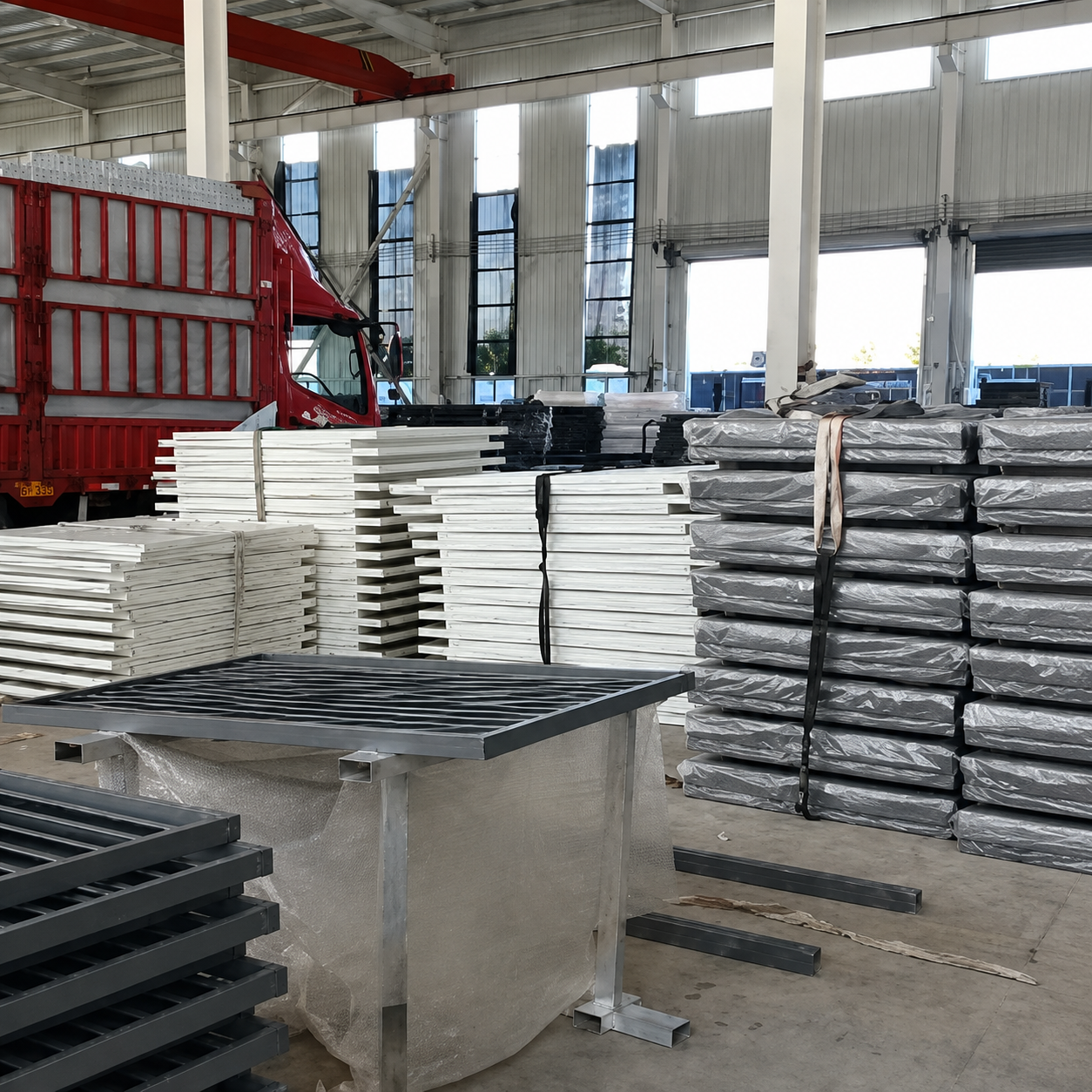
Junsu Outdoor (Henan Junsu Technology Co., Ltd.) is a supplier of integrated outdoor courtyard solutions — pergolas, aluminum fences, gates, screens and railings — operating since 2001 in metal courtyard product manufacturing and international trade. Its stated business scope runs from product customization and manufacturing through to installation guidance, technical support, spare parts and after-sales service, so support is positioned as part of the delivery model rather than an add-on. The company works from a 30,000 m² manufacturing base with a 120-person team, an annual output of approximately 36,000 sets, and a 10-engineer R&D team, exporting around 90% of output to markets including the EU, USA, France, Germany, Canada and Australia.
The after-sales scope a buyer can plan around includes:
- Fault response and product maintenance guidance. The first line of support is diagnosis and instruction: what the symptom indicates, what to check on site, and whether the fix is an adjustment, a part, or an installation correction.
- Long-term warranty service. Warranty service is handled as a continuing commitment rather than a single claim window. Because coverage depends on the product, configuration and order, the specific warranty terms for a project should be confirmed in the order documentation instead of assumed from a general figure.
- Free technical consultation. Configuration questions — pergola size, opening method, accessory selection, gate type, motor choice — can be discussed before and after purchase, which matters most for buyers specifying a system for the first time.
- Spare parts supply. Replacement components are sourced against the recorded configuration and the technical drawings issued for the order.
- Lifelong technical support. Support is not time-limited to the warranty period; technical questions about operation, adjustment and compatibility remain answerable as the system ages.
- Remote installation guidance and remote system debugging. Installation drawings, design optimisation and remote troubleshooting let a local installer execute the work without waiting for an on-site visit.
The manufacturing side of the model matters to after-sales because it defines how much is known about each unit. Quality control runs through the entire production process — raw material inspection, manufacturing, assembly, functional checks, pre-shipment inspection and packaging inspection — with 100% inspection before delivery. The company also works with authorised third-party testing institutions, and both raw materials and finished goods undergo layer-by-layer sampling inspection before shipment. For aluminium products, 6063-T5 aluminium alloy is the standard material, and customization can be based on CAD drawings, architectural plans, sketches, photos, dimensions and samples, with technical drawings, installation drawings, custom logos, private labels and packaging available.
How a Support Case Runs, Step by Step
The sequence below shows how the supported service elements fit together when something needs attention. It is a practical order of work rather than a promise of a fixed response time: the faster the first step is done well, the fewer steps follow.
- Identify the unit and the configuration. Record the product type, model or size, finish, motor and accessory combination, and order reference. For a pergola, this includes whether the roof is manual or electric and which accessories are fitted, such as a zip screen, glass door, fan, heater, or wind and rain sensor. For a gate, it includes the gate type, leaf or panel dimensions and the access-control method.
- Describe the symptom with evidence. Photos and short videos taken in daylight, plus a note of when the fault appears, give a technician far more than a written description. For electrical symptoms, state the power supply situation and whether water has been standing at the base or around the cable entry.
- Run remote diagnosis. Remote system debugging works through the control chain in order: power supply, wiring and cable routing, control settings, sensor input, then the motor or operator. Many reported faults resolve at the setting or wiring stage without any part being shipped.
- Choose the resolution path. The outcome is an adjustment instruction, a corrected installation detail, a replacement part, or a recommendation for the local installer to attend site. Remote installation guidance supports the last option with drawings and step-by-step direction.
- Confirm and record. After the fix, confirm normal operation and update the unit record so the next case — even years later — starts from a known configuration rather than from scratch.
Spare Parts: What to Settle Before the First Order
Spare parts planning is a pre-order activity. A replacement louver blade, gate hinge set or control component can only be matched confidently if the supplier still has the specification that produced the original, which is why the drawings issued for an order are as important as the parts themselves.
Four items are worth agreeing at order stage. First, which components are replaceable and how each is identified on the drawings. Second, which finish and colour code applies, because a replacement panel or blade that does not match the batch will be visible on a facade even if it functions correctly. Third, whether the buyer wants a small holding of critical components on site — a sensible option for hotels, resorts and municipal projects where a single non-functioning gate affects access for many people. Fourth, who is authorised to install replacements, since motor and control work should follow the installation requirements rather than improvisation.
For distributors and importers, the same logic supports a service business rather than only a sales business. A partner who holds drawings, a finish reference and a small stock of parts can resolve most issues locally, which protects the end customer's experience and reduces the cost of every claim.
Maintenance Guidance That Matches the Product
Aluminium outdoor systems are specified for low maintenance, and the finish does most of that work. A premium fluorocarbon and wood grain transfer finish is described as UV, salt spray and rain resistant with 20-year colour stability, on a rustproof aluminium alloy construction that is corrosion free. In practice, maintenance is limited to regular light cleaning; no annual rust removal, repainting or seasonal anti-corrosion treatment is required.
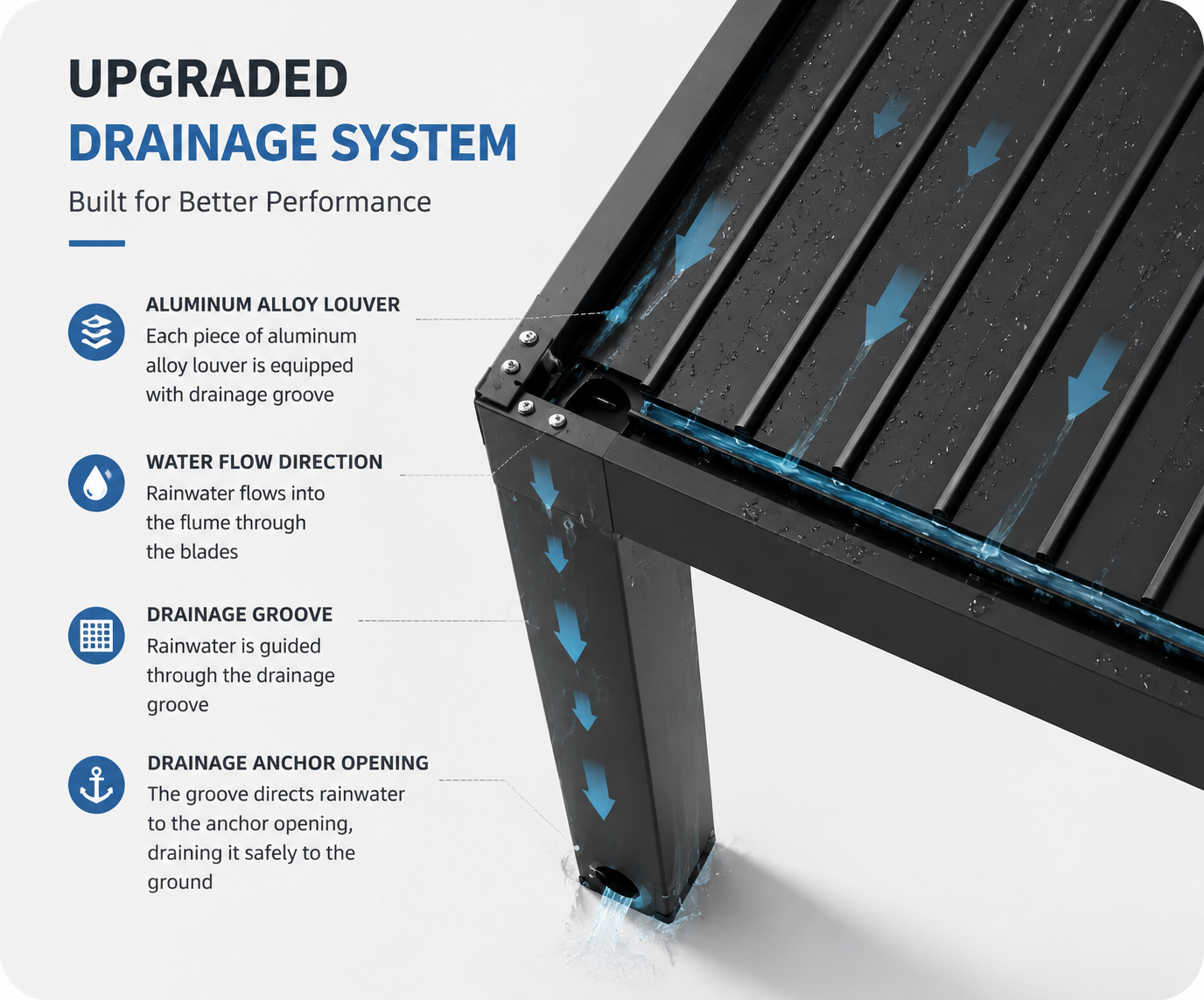
Water management is the one routine behaviour worth teaching every end user. On a louvered pergola, the roof is designed for outdoor all-weather use: when the louvers are fully closed, rainwater is collected through the integrated drainage channels and guided through the internal drainage system inside the posts. Proper installation and site drainage remain important to achieving the best waterproof performance, so gutters, outlets and the ground around the post bases should be kept clear.
Electrical maintenance is mostly preventive. The motorised pergola system is designed for outdoor applications, with the motor, wiring and control components installed with outdoor protection requirements in mind, but correct installation is essential — particularly for electrical connections and cable routing — and components should never remain submerged in standing water. Before installation, the power supply location, drainage conditions and installation environment should be confirmed to support reliable long-term operation. Where the product documentation states design parameters, they belong in the maintenance plan too: the pergola range is documented with a 100 kg/m² snow load and 120 km/h wind resistance, and keeping the roof free of accumulated snow and debris helps the structure work within those figures.
Remote Installation Guidance and System Debugging
Most of Junsu Outdoor's customers install thousands of kilometres from the factory, so support has to travel as information rather than as people. That is the purpose of installation drawings, design optimisation and remote system debugging: the local installer keeps control of the site while the supplier supplies the sequence, the settings and the checks.
In practice, remote guidance is most valuable at three moments. At setting out, when the mounting surface, fixing points and fall or drainage direction are fixed. At commissioning, when the motor limits, control pairing and sensor behaviour are set — the point where the power supply position, drainage and cable routing confirmed earlier either help or hinder. And at handover, when the end user is shown how to close the louvers before rain, how to isolate power safely and which symptoms justify a call rather than an adjustment.
Access control follows the same pattern on the gate side. Automatic aluminium gates can be configured with remote control, fingerprint recognition, password keypad, card access and mobile app control, with the motor and control system selected according to gate type, gate size, weight and installation conditions. When several access methods are combined, remote debugging is usually faster than on-site attendance, because settings can be checked methodically against the documented configuration.
What to Prepare Before Ordering
Accurate pre-order information is the cheapest form of after-sales support, because it prevents the problems that support teams otherwise spend years resolving. For a custom aluminium gate, the required inputs are the clear opening width and height, the preferred gate type, the quantity and clear site photos. For automatic gates, the ground condition, posts or walls, available side space and power supply location are also needed. With accurate site information, the gate structure, opening direction and motor installation can be evaluated before production.
Dimensional tolerance inspection is best treated as an agreed procedure rather than an assumption. Buyers should state which dimensions will be verified on arrival — clear opening, overall frame dimensions, post spacing, fixing centres — and how they will be measured, so that the inspection record matches the site conditions the product was designed for. Junsu Outdoor's acceptance route supports this: acceptance is through pre-shipment test procedures, quality control includes functional checks and packaging inspection, and every order is 100% inspected before delivery, alongside layer-by-layer sampling of raw materials and finished goods and cooperation with authorised third-party testing institutions.
Purchasing Terms and Acceptance at a Glance
The commercial framework is deliberately simple, which helps buyers compare offers on the same basis. Minimum order quantity is 1 set, delivery terms can be FCA, FOB, CIF, DAP or DDP, acceptance is through a pre-shipment test, and payment is 50% deposit with 50% balance before shipment.
| Item | Stated term | What it means for a first order |
|---|---|---|
| Minimum order quantity | 1 set | A single pergola or gate can be ordered for evaluation before a project-scale commitment. |
| Delivery terms | FCA / FOB / CIF / DAP / DDP | Responsibility for freight and import formalities is chosen at quotation, not assumed. |
| Payment | 50% deposit, 50% before shipment | Balance is settled against the pre-shipment stage, alongside inspection. |
| Acceptance criteria | Pre-shipment test | Verification happens before dispatch, so dimensional and functional checks are agreed in advance. |
| Inspection routine | 100% inspection before delivery; layer-by-layer sampling | Finished goods and raw materials are both checked before shipment. |
Gate Type Quick Comparison
Gate selection affects both installation and long-term service, because the type decides how much space, hardware and motor duty the entrance needs. The differences below are the ones that most often change the specification.
| Gate type | Space condition it suits | What to confirm before production |
|---|---|---|
| Swing gate | Where sufficient inward or outward opening space is available | Clear opening width and height, opening direction, post or wall condition |
| Sliding gate | Where there is enough lateral space beside the entrance | Lateral run, ground condition, drainage, power supply location |
| Bi-fold gate | Where the driveway has limited opening depth and a compact solution is needed | Available depth, leaf dimensions, motor position, side space |
All three types can be customised to project dimensions. Site dimensions and clear photos allow the installation space to be evaluated and a suitable configuration recommended before drawings are finalised.
Support in Practice: Three Buyer Situations
Support requirements differ by buyer, and the same service scope is used differently in each case. The three situations below are illustrative rather than reported customer cases.
A villa owner fitting one system. The priority is a correct first installation and a simple route for questions. Confirming power supply, drainage and mounting surface before installation, and keeping the pergola's configuration and finish code with the handover documents, means a later query about a louver blade or a remote-control pairing can be answered without a site visit. The 1-set minimum order quantity allows this buyer to evaluate a single system rather than commit to a container.
A hotel or resort standardising outdoor areas. Here the risk is repetition: many identical pergolas and gates, one of which will eventually need a matching replacement part in front of guests. Standardising profile, colour code and accessory list across the property, and holding a small stock of critical components on site, protects both appearance and access. Remote debugging is especially useful because a single control fault can be diagnosed while the maintenance team is standing at the unit.
A distributor or importer building a service offer. The commercial value lies in local resolution. A partner who holds technical drawings, installation drawings and a finish reference can install, adjust and repair without waiting for factory support, and can order spare parts against a documented configuration. Private-label and custom packaging options let the same partner present the range under its own identity while keeping the factory's technical record intact.
Frequently Asked Questions
Will the product rust in coastal, humid or rainy areas, and does it need frequent maintenance?
Aluminium outdoor living systems from Junsu Outdoor use 6063-T5 aluminium alloy as the standard material, with a premium fluorocarbon and wood grain transfer finish described as UV, salt spray and rain resistant with 20-year colour stability. The construction is rustproof aluminium alloy and corrosion free. Maintenance is limited to regular light cleaning — no annual rust removal, repainting or seasonal anti-corrosion treatment is required.
Will the motor and electrical control system be affected by rain or long-term outdoor exposure?
The motorised aluminium pergola is designed for outdoor applications, and the motor, wiring and control components are installed with outdoor protection requirements in mind. Correct installation is essential, especially for electrical connections and cable routing, and electrical components should not remain submerged in standing water. Before installation, the power supply location, drainage conditions and installation environment should be confirmed; installation guidance and technical support are available according to the selected pergola configuration.
Is the aluminium louvered pergola waterproof in heavy rain?
The louvered pergola is designed for outdoor all-weather use. When the louvers are fully closed, rainwater is collected through the integrated drainage channels and guided through the internal drainage system inside the posts. Proper installation and site drainage are important for achieving the best waterproof performance, so outlets and the ground around the posts should be kept clear.
What information do I need to provide before ordering a custom aluminium gate?
For an accurate gate design and quotation, provide the clear opening width and height, preferred gate type, quantity and site photos. For automatic gates, information about the ground condition, posts or walls, available side space and power supply location is also helpful. Accurate site information allows the gate structure, opening direction and motor installation to be evaluated before production, and drawings can be prepared and confirmed according to project dimensions before manufacturing.
Should I choose a sliding gate, swing gate or bi-fold gate for my driveway?
The suitable type depends mainly on driveway width, available opening space, ground conditions and the required opening speed. Swing gates suit sites with enough inward or outward opening space; sliding gates suit entrances with enough lateral space beside them; bi-fold gates are useful where the driveway has limited opening depth and a compact opening solution is needed. All three can be customised, and site dimensions with clear photos allow a recommendation before drawings are finalised.
What are the purchasing terms and acceptance criteria?
Minimum order quantity is 1 set. Delivery terms are FCA, FOB, CIF, DAP or DDP. Acceptance criteria are a pre-shipment test, supported by quality control that runs from raw material inspection through assembly, functional checks, pre-shipment inspection and packaging inspection, with 100% inspection before delivery. Payment terms are 50% deposit and 50% balance before shipment.
What is the minimum order quantity if I want a sample first?
The minimum order quantity is 1 set, so a single pergola, fence run or gate can be ordered for evaluation before a larger commitment. If you want to discuss a sample configuration, a technical drawing set or a quotation, send the intended application, dimensions and site information to JunSu@junsutech.com or +86 135-2556-8065 and the team can respond against a documented specification.
Conclusion: Support Is a Long-Term Specification Item
After year one, an outdoor living system is judged on continuity rather than on the delivery photos. The elements that make continuity possible are unglamorous and easy to check in advance: a documented configuration, drawings that identify parts, a finish code that can be matched, a drainage design that works on site, and a supplier whose support scope explicitly includes fault response, maintenance guidance, warranty service, free technical consultation, spare parts, lifelong technical support, and remote installation guidance with remote system debugging.
For buyers comparing long-term partners, the practical test is to ask three questions before signing: how a fault would be diagnosed remotely, how a replacement component would be identified and matched, and what information the supplier needs at order stage to make both possible. Junsu Outdoor's 15-year long-term use duration and 600-set, 10-country delivery record describe the scale of that commitment; the drawings, inspection records and parts references describe how it is delivered.
Next step. Review the full product range in the Junsu Outdoor product catalog (PDF), or send your application, dimensions and site conditions for a technical consultation on configuration, spare parts planning and installation guidance. Contact: Su, JunSu@junsutech.com, +86 135-2556-8065, WhatsApp +86 135-2556-8065.