- Industry News
- 504
Outdoor Living Solutions: Cutting Long-Term Maintenance Costs in High-Wind and Snow-Load Yards
How a coordinated Outdoor Living Solutions package — aluminum bioclimatic pergola, louver fence and automatic gate — cuts long-term maintenance costs in high-wind and snow-load yards.
In an exposed yard — coastal, hillside, or inland with a heavy winter snow season — the first invoice is rarely the expensive one. The expensive invoices arrive later: repainting rusted iron, replacing panels after a load event, retrofitting privacy screening that should have been specified at the start, and repairing entrance automation that was bought separately from the pergola and the fence.
This guide is written for villa owners and project clients at the decision stage of an outdoor living procurement, where the comparison has moved past appearance and into total cost of ownership. It explains where long-term maintenance cost actually comes from in high-wind and snow-load yards, and how one coordinated Outdoor Living Solutions package — aluminum bioclimatic pergola, aluminum garden fence and aluminum driveway gate, specified together — closes each of those cost lines.
Why High-Wind and Snow-Load Yards Cost More to Own
Exposure is the multiplier. On an open site, wind drives rain and salt spray into every joint and fixing, snow sits as dead load on horizontal surfaces for weeks at a time, and freeze-thaw cycles work on any finish that has already been scratched. A structure that performs acceptably in a sheltered garden can generate continuous repair work on an exposed one — and the owner pays for that work every year in labour, replacement parts, and lost use of the space while it is being repaired.
That is why a decision-stage comparison should be built on a defined ownership horizon rather than on purchase price alone. The practical question is not what the pergola, fence and gate cost in month one, but what they cost to keep in service across a 15-year planning horizon — a reasonable baseline for a villa or small commercial project.
Problem Definition: Four Cost Leaks in an Exposed Outdoor Space
1. Corrosion and finish breakdown
Painted iron and untreated timber generate the most recurring cost on exposed sites, because both require a repeating surface cycle: rust removal and repainting for iron, refinishing and replacement of decayed sections for timber. In salt-spray or high-humidity conditions that cycle shortens, and the labour is rarely a one-person job once fixings have seized.
2. Load events and deformation
Snow load is a design input, not a weather surprise. Where a roof structure is under-specified, the outcome is usually not a dramatic collapse but a slow failure: louvres that no longer close squarely, joints that leak, and drainage that stops running to the outlet because the frame has moved.
3. Privacy gaps that force a retrofit
Privacy decisions are often made late. A fence that does not close the sightline from a neighbouring upper floor, or a gap between the pergola and the boundary wall, produces a second purchase — extra panels, screens, or planting that itself needs maintenance.
4. Small mechanical failures with disproportionate cost
Moving parts fail first, and they fail expensively because the repair is not local: a seized motor, a mis-set limit switch, or a gate that no longer aligns with its posts. Access to technical support and spare parts matters as much as the mechanism itself, which is why buying pergola, fence and gate from one supplier shortens the repair path.
Industry Background: Why Aluminum Systems Now Dominate Exposed-Site Procurement
Aluminum pergola demand has grown large enough to be tracked as its own market. The global aluminum pergola market was valued at US$3.8 billion in 2025 and is projected to reach US$7.1 billion by 2034 (Dataintelo, Aluminum Pergola Market Research Report 2034). North America alone accounted for a 34.2% share of that demand in 2025.
The adjustable-louvre segment is growing inside that total: the global bioclimatic pergola market is forecast to move from US$600.87 million in 2026 to US$1,049.46 million by 2034, a CAGR of 7.22% (Fortune Business Insights). On the entrance side, automatic sliding gates held a 30.2% share of the automatic gate opening system market in 2025 — evidence that a driveway entrance is now usually specified as an automated access point rather than a manual gate.
Regulation has matured alongside the product. In the European Union, EN 13561:2015 sets performance and safety requirements for external blinds and awnings, including pergola awnings. In the United States, ASTM F2957 covers ornamental aluminum fence systems, including structural testing and surface finish. Buyers importing aluminum fence panel kits from China should also plan for classification under HTSUS 7610.90.0080, which carries a duty rate of 5.7% (U.S. Customs and Border Protection ruling NY N169385).
What this means at the decision stage: the market signal is secondary. The specification signal is what matters — these products are now mature enough that a coordinated package can be sourced from a single manufacturer instead of being assembled from three suppliers with three colour systems and three warranty contacts.
The Solution: One Coordinated Package Instead of Three Separate Purchases
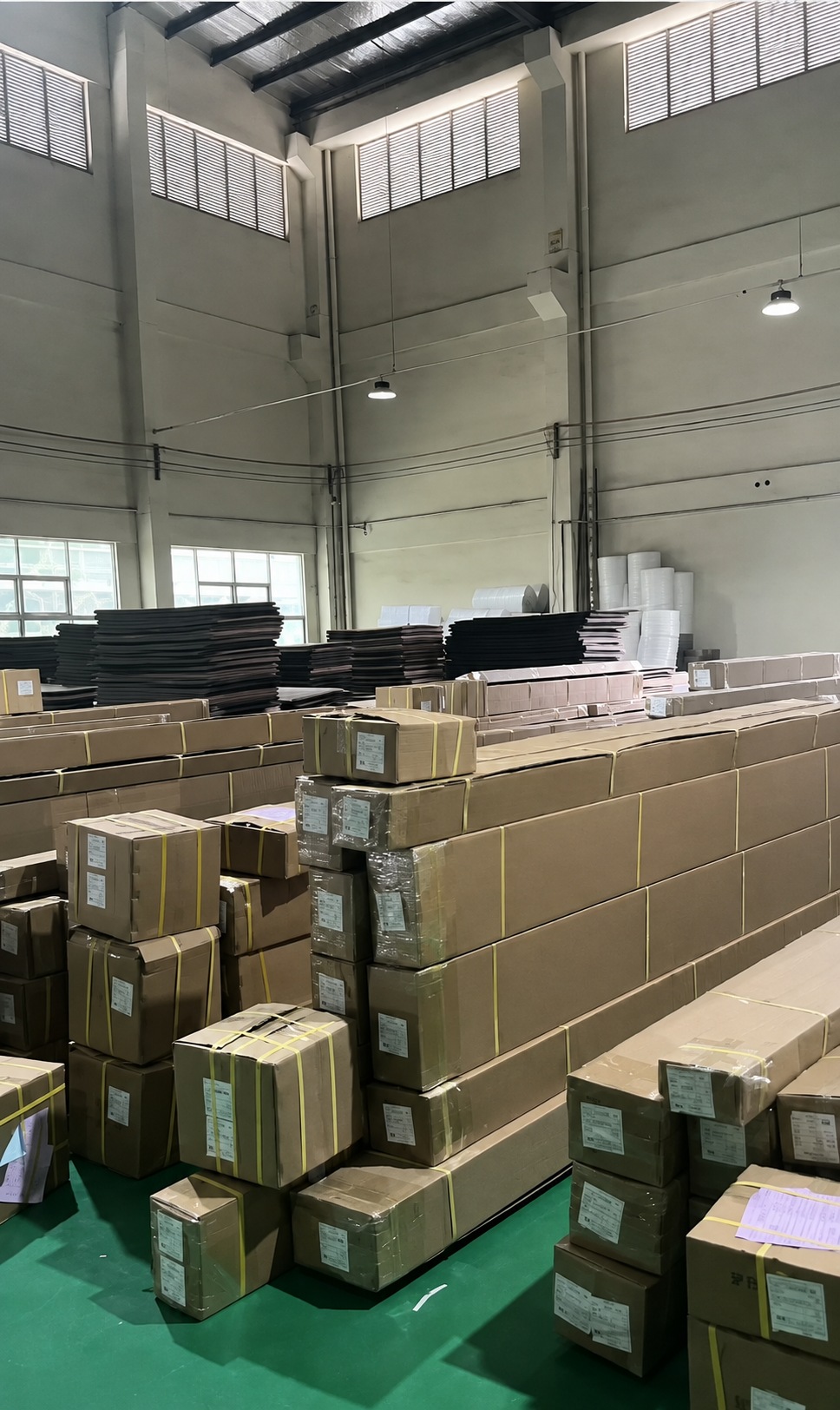
Junsu Outdoor is the outdoor living brand of Henan Junsu Technology Co., Ltd., a manufacturer based in Zhengzhou, Henan, China, that has produced and exported metal courtyard products since 2001. The company operates a 30,000 m² manufacturing base with a 120-person team, an annual output of approximately 36,000 sets, a 10-engineer R&D team, and around 90% of output exported to the EU, USA, France, Germany, Canada and Australia. Aluminum products use 6063-T5 aluminum alloy as standard material, and the quality system is supported by ISO 9001 and CE certification.
Weather resistance is a material property, not a coating claim
The integrated aluminum alloy structure delivers 0 rust and 0 peeling within 20 years, with a 99% colour retention rate for long-term outdoor use. Expected service life is three times longer than traditional iron and wood products, and the replacement cycle is 3–6 times longer. Wind resistance stability is three times higher than that of traditional facilities. For a buyer planning across 15 years, this is the core of the cost argument: the surface does not require an annual anti-corrosion programme.
The bioclimatic pergola: load capacity and water management
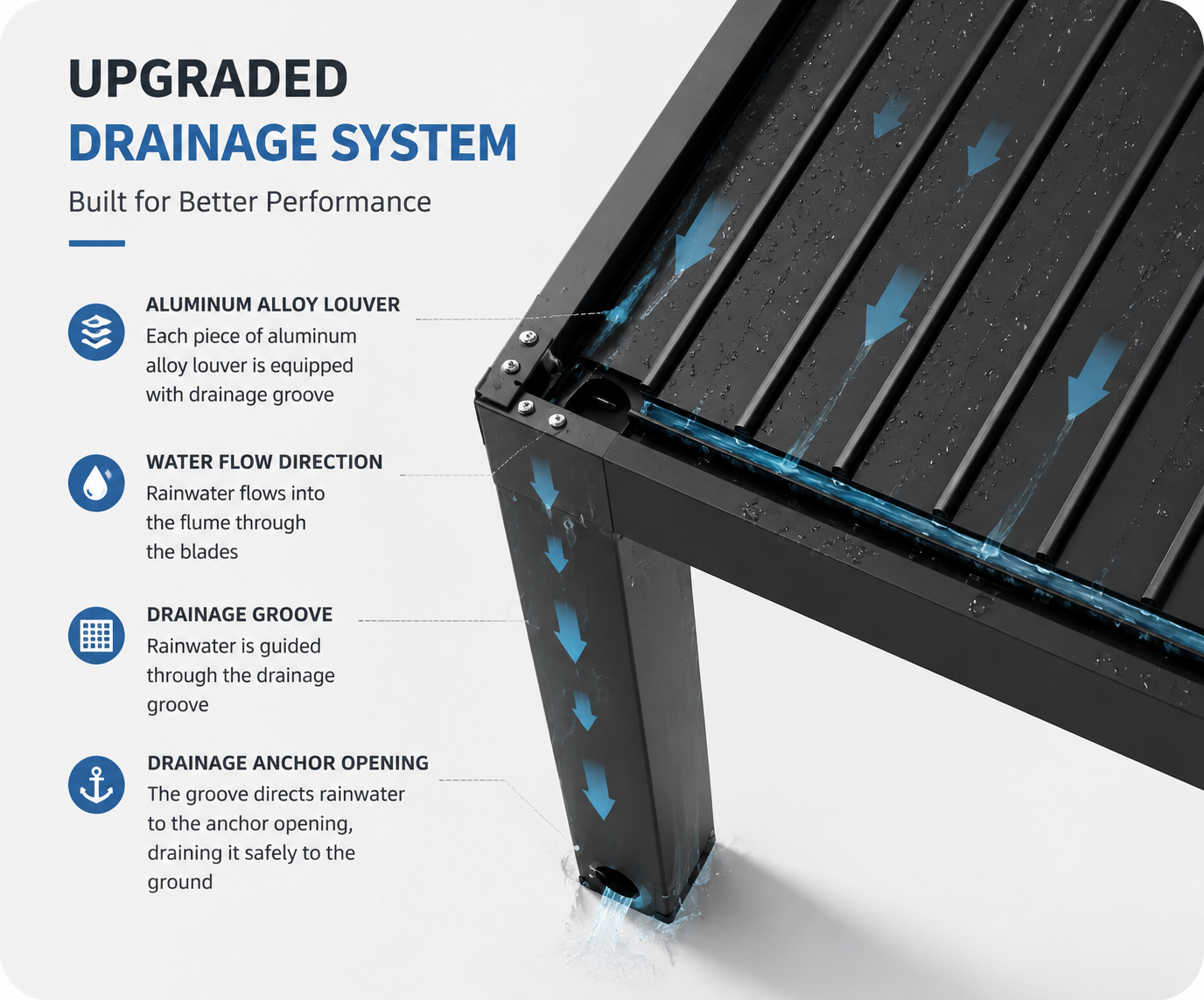
The motorized aluminum bioclimatic pergola uses adjustable louvres instead of a fixed roof. Product data lists a snow load of 100 kg/m² (approximately 20.5 lb/ft²) and wind resistance of 120 km/h (approximately 75 mph), with an operating temperature range of -35°C to 65°C and IP66 protection for the electrical assembly. When the louvres are fully closed, rainwater is collected through integrated drainage channels and guided through the internal drainage system inside the posts; correct installation and site drainage are both required for that system to perform. Standard sizes are 3×3 m, 3×4 m, 4×4 m and 3×6 m, and dimensions, colours and patterns are customizable.
The aluminum garden fence: privacy without sealing the site
Aluminum louver fencing uses angled slats to reduce direct visibility while maintaining airflow through the fence. That makes it usable not only for residential privacy, but also for patios, courtyards, HVAC equipment screens and commercial mechanical enclosures where ventilation is required. Dimensions and configurations are customizable to the project, so a fence line can follow the boundary rather than forcing the boundary to fit a stock panel. Welded, modular and spliced construction options each suit different site conditions.
The automatic driveway gate: access control that matches the site
Gate type follows the driveway, not the catalogue. Swing gates suit sites with enough inward or outward opening space; sliding gates suit entrances with lateral space beside the opening; bi-fold gates are the practical answer where opening depth is limited. On the control side, automatic aluminum gates can be configured with remote control, fingerprint recognition, password keypad, card access and mobile app control, with the motor and control system selected according to gate type, size, weight and installation conditions.
Why coordination is the actual saving
Pergola, fence and gate bought separately rarely match. A single factory producing all three applies unified profiles, colour codes and craft, so the finish on the gate posts matches the pergola columns and the fence rails under the same light. Coordination also removes the most common hidden cost on exposed sites — a second delivery, a second installation crew, and a second colour that never quite agrees.
Running cost is part of the same package. On automated pergolas the intelligent motor reduces standby power by 85%, with near-zero standby consumption; the pergola cavity structure lowers temperature by 3–5°C and blocks UV heat; static fence and gate sections consume no energy at all; and aluminum is 100% recyclable, reducing reprocessing energy by 70%. Solar compatibility allows zero electricity cost for the pergola drive in suitable installations.
Step-by-Step Breakdown: Specifying for a Wind- and Snow-Exposed Yard
The sequence below is the order in which decisions should be locked. Changing an earlier step later is what usually creates the cost overrun.
- Map the site exposure. Record prevailing wind direction, snow accumulation zones, salt-spray distance and drainage fall across the yard. This decides where a free-standing structure is acceptable and where a wall-mounted pergola is the safer fixing.
- Fix the load requirement against product data. Confirm the snow load and wind resistance figures for the selected model against the current data sheet — 100 kg/m² and 120 km/h in the standard Junsu Outdoor specification — and match them to local conditions rather than assuming a default.
- Set geometry and layout. Choose from 3×3 m, 3×4 m, 4×4 m or 3×6 m standard spans, or specify custom dimensions, and set the fence line and gate opening in the same drawing so the three elements align.
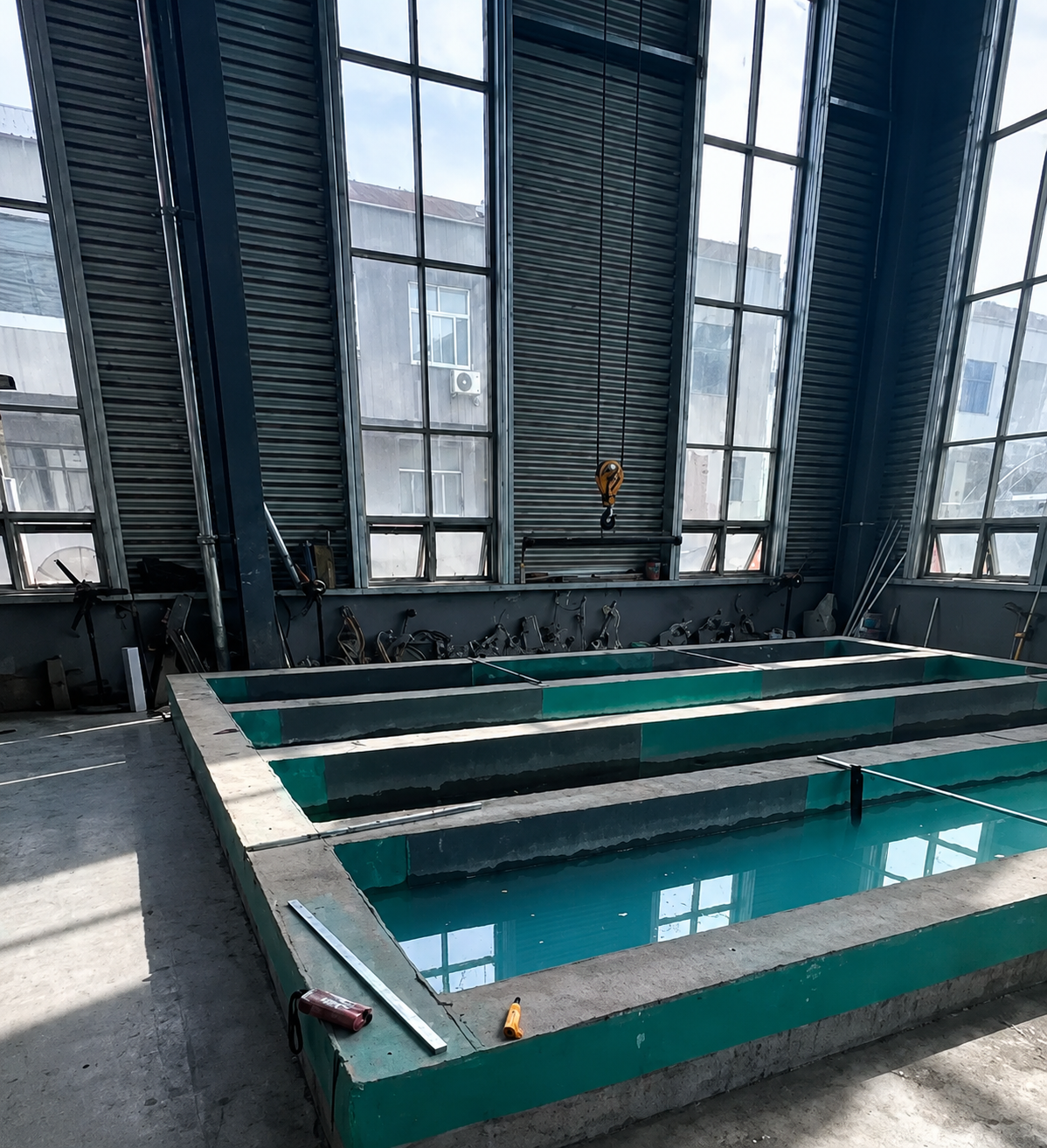
- Lock finishes, colours and patterns. Select one colour code across pergola, fence and gate. Surface preparation — including pickling before coating — is where long-term colour retention is decided.
- Decide automation and access. Choose manual or electric roof operation, then the gate drive and access method: remote, fingerprint, keypad, card or app. Confirm power supply location and site drainage before motor installation.
- Confirm drawings and production slot. Technical drawings and design optimization are prepared and confirmed against project dimensions. A minimum order of 1 set is accepted, and production lead time is 30 days from confirmed drawings — usable for a single-villa order as well as a multi-unit project.
- Plan installation and the annual routine. Integrated finished-product delivery shortens the on-site installation period. After handover, the maintenance routine is light cleaning plus an annual check of drainage outlets, fixings and the electrical connection — no rust removal, no repainting, no seasonal anti-corrosion treatment.
Use Cases
Coastal villa with salt spray and driven rain
The failure pattern here is finish-led: iron fixings and painted sections corrode first, and repainting becomes an annual event. A rustproof aluminum package with 0 rust and 0 peeling within 20 years removes that cycle, and a louver fence gives privacy without blocking the coastal airflow that keeps the terrace usable.
Mountain courtyard with a heavy snow season
Snow load and snowmelt are the constraints. A bioclimatic roof specified at 100 kg/m², closed in winter and drained through the internal post channels, keeps the structure stable and prevents meltwater from pooling at the base. A sliding or bi-fold gate is often the better fit where snow restricts swing clearance.
Residential compound with privacy and controlled access
Where the owner manages multiple entrances, the gate becomes an access-control device rather than a barrier. Fingerprint, keypad, card and app control allow different access levels for family, staff and visitors, while a coordinated fence line keeps the perimeter visually consistent — one colour code, one profile family, one supplier for spare parts.
Comparison Table: Coordinated Aluminum Package vs Traditional Options
| Option | Corrosion and finish behaviour | Recurring maintenance | Replacement cycle | Coordination of pergola, fence and gate |
|---|---|---|---|---|
| Coordinated aluminum package (Junsu Outdoor) | 0 rust and 0 peeling within 20 years; 99% colour retention | No annual anti-corrosion or repainting work; routine light cleaning | Service life 3× traditional iron and wood; 3–6× longer replacement cycle | Single factory; unified profiles, colour codes and craft |
| Painted iron or steel | Rust removal and repainting cycles; corrosion concentrated at welds and fixings | Continuous annual upkeep | Baseline for comparison | Usually three separate suppliers |
| Timber | Refinishing required; decay in damp sections | Continuous refinishing and section replacement | Baseline for comparison | Separate trades and finishes |
| Brick or masonry boundary | No rust, but staining and cracking require structural repair | Low painting load, higher structural repair load | Long, but effectively permanent and immovable | Gate still sourced separately; no colour system to match |
| Stainless steel | Corrosion-resistant, but finish can mark and material cost is higher | Moderate cleaning requirement | Medium | Limited colour coordination with aluminum elements |
Figures in the aluminum row come from Junsu Outdoor product data. Other rows describe general maintenance behaviour of those material categories and are not measured test results.
Frequently Asked Questions
Will aluminum pergolas, fences and gates rust in coastal, humid or snowy areas, and how much maintenance does that require?
Premium fluorocarbon and wood-grain transfer finishes used on these products are UV, salt-spray and rain resistant, with 20-year colour stability. The construction is rustproof aluminum alloy, so there is no rust removal or repainting cycle. Product data states 0 rust and 0 peeling within 20 years with a 99% colour retention rate, and routine upkeep is limited to regular light cleaning. In heavy snow regions, confirm the specified snow load and the drainage path against the current data sheet before ordering.
What smart access options are available for an automatic aluminum gate?
Automatic aluminum gates can be configured with remote control, fingerprint recognition, password keypad, card access and mobile app control. The motor and control system are selected according to gate type — sliding, swing or bi-fold — plus gate size, weight and installation conditions. Opening direction, ground condition, available side space and power supply location are confirmed before production begins.
Is a coordinated aluminum package more expensive than iron or timber alternatives?
The one-time procurement cost is slightly higher than traditional alternatives. The long-term comprehensive cost is 70%–80% lower, maintenance workload is around 90% lower, expected service life is three times that of traditional iron and wood products, and the replacement cycle is 3–6 times longer. On automated pergolas the intelligent motor also reduces standby power by 85%, with near-zero standby consumption.
What information is needed to quote and produce a custom gate, fence or pergola?
For an accurate gate design and quotation, provide the clear opening width and height, preferred gate type, quantity and site photos. For automatic gates, also provide the ground condition, posts or walls, available side space and power supply location. Accurate site information allows the structure, opening direction and motor installation to be evaluated before production, and drawings can be prepared and confirmed according to project dimensions. A minimum order of 1 set is accepted, so a first set can validate finish, colour and fit before a larger project order.
What is the production lead time, and how does a project start?
Production lead time is 30 days from confirmed drawings and order details. Because the pergola, fence and gate can be produced in one factory with unified profiles and colour codes, the three items are scheduled together instead of in three separate queues. A project starts with dimensions, site photos and the intended layout; a quotation and drawings follow. The full product catalog can be downloaded at Junsu Products Catalog (PDF) for a first review.
Conclusion: The Decision Rule for Exposed Yards
In a high-wind or snow-load yard, the lowest-cost outdoor living decision is the one that removes the recurring cost. Aluminum is chosen there not for appearance but because it removes rust removal, repainting and seasonal anti-corrosion treatment from the annual budget, while delivering three times the wind resistance stability of traditional facilities and a service life three times longer than iron and wood.
Specify the three elements together — bioclimatic pergola for shade, rain and snow management; louver fence for privacy with airflow; automatic gate for controlled access — and hold one supplier accountable for colour, fit, drawings, spare parts and technical support. Sizing, colour, pattern and access control are customizable, a single set is an accepted starting order, and production runs 30 days from confirmed drawings.
Next step
Send your yard dimensions, site photos and load requirements to Junsu Outdoor for a coordinated quotation covering pergola, fence and driveway gate produced under one colour system.
Email: JunSu@junsutech.com | Tel / WhatsApp: +86 135-2556-8065
Website: www.junsu-outdoor.com