
- Industry News
- 542
Outdoor Living Solutions: What Is a Welded Aluminum Fence?
A welded aluminum fence is defined by fused joints, a uniform coated finish and rigid panels. Learn how it differs from garden and modular spliced fences, plus specs, standards and lead time.
Outdoor Living Solutions · Definition, Construction and Specification
Outdoor Living Solutions: What Is a Welded Aluminum Fence?
A welded aluminum fence is an aluminum fence system whose panel bars, rails and frame are joined by welding into one rigid unit at the factory, before surface coating. Because the joints are fused rather than clipped, spliced or bolted together on site, the finished panel behaves as a single structure, carries a continuous coating system across the joint, and holds its geometry when lifted, aligned and fixed into position.
This guide is written for buyers who are past the discovery stage and are now evaluating specifications: specifiers, importers, distributors, landscape and construction contractors, and real estate developers. It separates the three labels that are routinely used as if they meant the same thing, lists the parameters that can actually be written into a purchase order, and shows where the welded type is the correct choice — and where it is not.
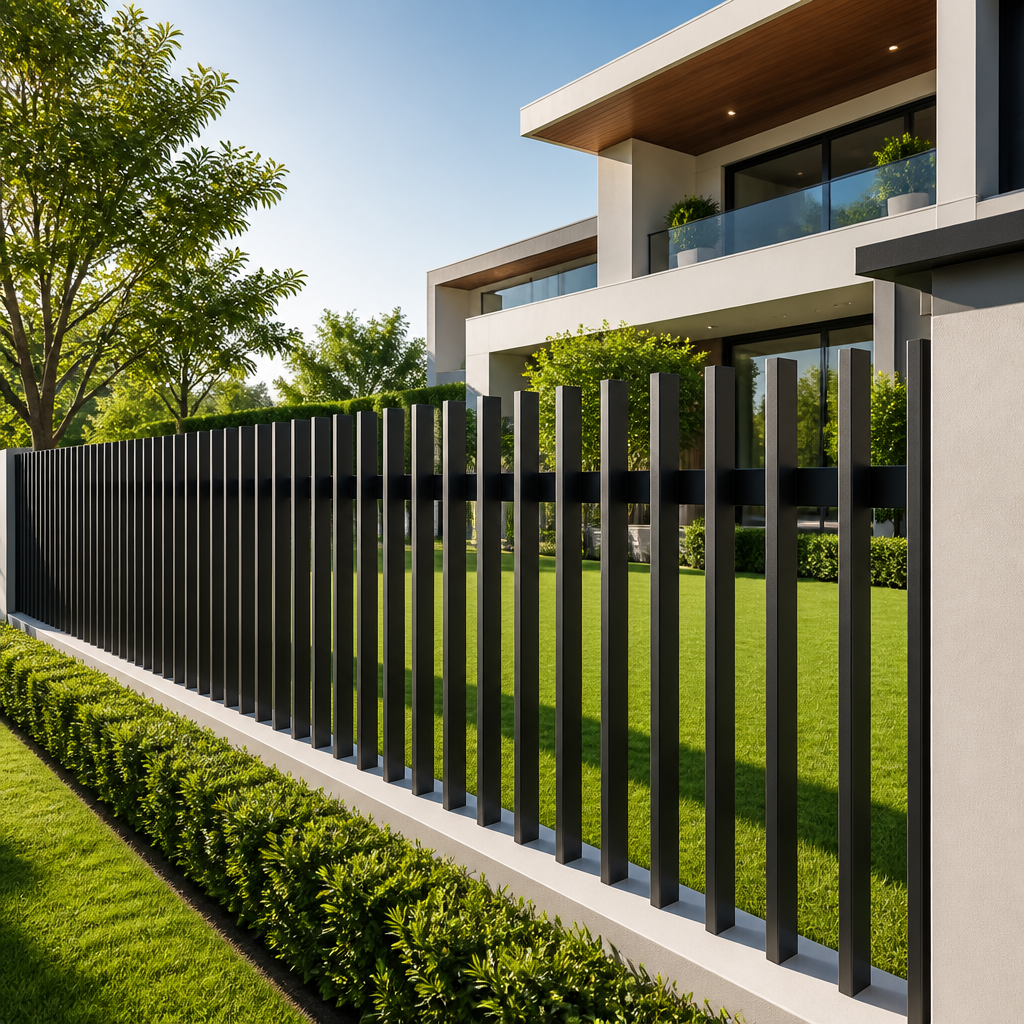
Welded aluminum vertical bar fence: the bars, rails and frame are joined into one rigid panel before coating, which is what separates it from a spliced panel.
The Problem: “Aluminum Fence” Is a Category, Not a Specification
A buyer who requests “an aluminum garden fence” and receives three quotations is usually not comparing the same product. The phrase covers at least three different purchases:
- Garden fence — an application label. It says the fence encloses a garden, courtyard or planted area, but says nothing about how the fence is built.
- Modular spliced fence — an assembly method. Bars, rails and posts are produced as separate components and joined with mechanical connectors during installation.
- Welded fence — a construction method. The bars, rails and frame of a panel are fused by welding into one unit, so the joint is metallurgical rather than mechanical.
Two quotations can use identical wording and still differ in joint type, profile wall thickness, coating system, bar spacing, bottom gap height and fixing detail. When those variables are left open, the price comparison measures nothing except how much risk each supplier has decided to absorb.
The second problem is system mismatch. When the fence, gate and pergola are sourced from three different suppliers, the project receives three different colour codes and three different surface crafts. On a villa courtyard or a residential community boundary, that difference is visible from the street before anyone reads a specification sheet. Junsu Outdoor answers this specific concern through one-stop customization from a single factory, using unified profiles, colour codes and craft across pergola, fence and gate.
The third problem is that durability claims are rarely tied to a condition. “Anti-rust” means very little unless it is connected to the alloy used, the coating system applied, and the climate the fence will actually face — a coastal boundary, an inland municipal park and a covered courtyard are three different service environments.
The fourth problem is documentation. A certificate name is not a document set. Buyers who need to justify a selection internally should ask for the test scope, the standard version, the inspection record and the pre-shipment check, not just the logo on a brochure.
Industry Background: Fences Are Increasingly Bought as Part of a Set
The global aluminum pergola market is valued at USD 3.8 billion in 2025 and is projected to reach USD 7.1 billion by 2034, according to Dataintelo, with North America holding a 34.2% share of global demand in 2025. The bioclimatic pergola segment is expected to grow from USD 600.87 million in 2026 to USD 1,049.46 million by 2034 at a CAGR of 7.22%, based on Fortune Business Insights data. Those figures describe pergolas rather than fences, but they explain a change in purchasing behaviour: where a pergola is specified, the same buyer usually reworks the boundary, the gate and the entrance within the same project cycle, and expects all three to read as one design.
The regulatory layer reinforces that trend. ASTM F2957 is the specific standard for ornamental aluminum fence systems and covers structural testing and surface finish. In the European Union, EN 13561 sets performance and safety requirements for external blinds and awnings, including pergola awnings. On the trade side, aluminum fence panel kits imported from China into the United States are classified under HTSUS 7610.90.0080 with a duty rate of 5.7%, per US Customs and Border Protection ruling NY N169385. A single outdoor living package can therefore touch a product standard, a safety standard and a tariff classification at the same time — which is another reason the fence should be specified rather than described.
Henan Junsu Technology Co., Ltd., trading as Junsu Outdoor, is an outdoor courtyard product manufacturer based in Zhengzhou, Henan, China, founded in 2001. The company produces aluminum pergolas, aluminum fences and automatic driveway gates from a 30,000 m² facility with 120 employees and an annual output of about 36,000 sets, and exports roughly 90% of its production to the EU, USA, France, Germany, Canada and Australia.
How a Welded Aluminum Fence Is Built
Material base: 6063-T5 aluminum alloy
Junsu Outdoor uses 6063-T5 aluminum alloy as the standard material for its aluminum products, and aluminum alloy is the primary material across its pergola, fence and gate system. Production runs from extrusion and cutting through welding, surface coating, assembly, inspection and packing — a sequence the company describes as covering the full process inside its own base.
What the weld actually changes
A welded joint is formed before coating, so the coating system is applied to an assembled unit rather than to loose bars that are joined later. That is the mechanical reason a welded panel can present a uniform surface finish across the whole face. Junsu Outdoor lists exquisite welding technology and uniform surface finish among the defining characteristics of its aluminum range, alongside high structural stability and anti-rust, weather-resistant construction.
In practice, a welded panel reduces the number of on-site joints a contractor has to align, keeps its geometry when lifted into position, and fixes bar spacing and pattern at the factory instead of at installation. Those three effects are what contractors usually mean when they say a boundary “looks straight”.
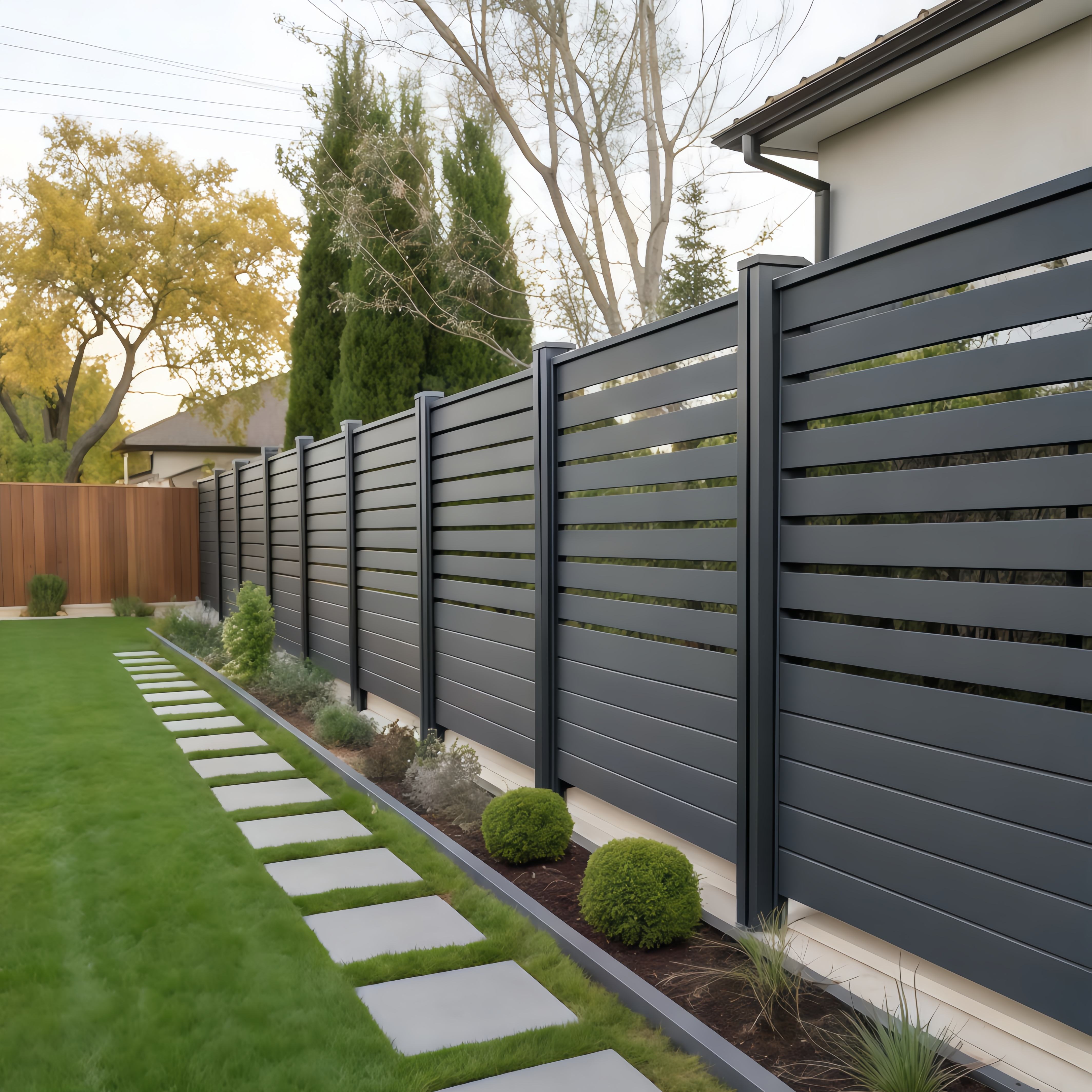
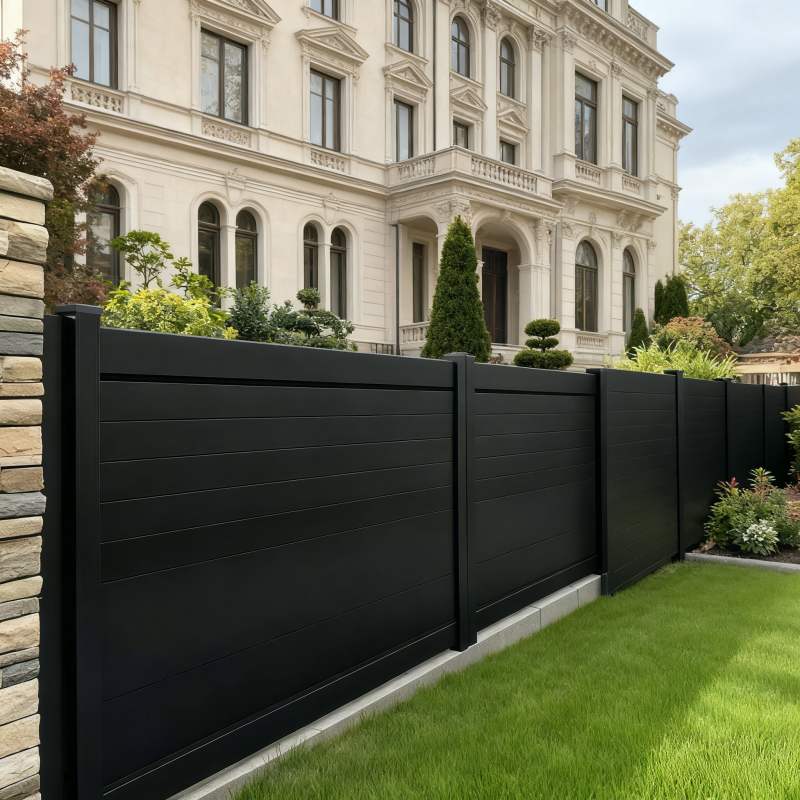
Horizontal slat aluminum fence: the coating is applied after the panel is welded, producing a continuous finish across rails and bars.
Anti-rust and weather resistance
Aluminum alloy construction is corrosion-free, and the surface system carries the appearance. Junsu Outdoor states that its premium fluorocarbon and wood grain transfer finishes are UV, salt spray and rain resistant with 20-year colour stability. The company's working-condition statement for the outdoor system covers a −35 °C to 65 °C range and IP66 waterproof and dustproof protection for smart pergolas, courtyard fences and villa entrance gates. For the owner, the practical consequence is that maintenance reduces to periodic light cleaning rather than annual rust removal, repainting or seasonal upkeep.
Structural stability — and the limit of the published numbers
A welded frame resists racking because the panel cannot rotate at its joints. That much is inherent to the construction method. What buyers should not do is transfer load figures from one product to another: the manufacturer's published ratings of up to 100 lb/sq ft snow load and up to 190 mph wind load apply to the pergola series. A fence panel should be specified against the project's own wind requirement, post spacing, foundation detail and fixing method, because the fence is anchored to the ground and exposed along its full length.
Uniform surface finish and colour matching
Because pergola, fence and gate can be produced from unified profiles, colour codes and craft in one factory, the boundary and the structure can be delivered as a single finish system. This is the concrete answer to the coordination question that appears in almost every villa or community project: will the pergola, fence and gate show mismatched colours if they are purchased separately? Ordered as one package, they do not, because the colour reference and the coating process are the same.
What can be customized on a welded fence
- Overall dimensions and panel width
- Alloy profile thickness
- RAL surface colour
- Hollow carving pattern and decorative detail
- Fence bar spacing
- Gate opening type and intelligent access system
- Lock and hardware style
- Engraved logo
- Anti-collision structure
- Bottom gap height and hidden installation fittings
Design input can be taken from CAD drawings, architectural plans, sketches, photos, dimensions and physical samples, with technical drawings, design optimisation and installation drawings returned before manufacture.
Where welded is the wrong choice
A welded panel is a rigid, low-flex unit. It occupies volume in transport and needs clear access at delivery. Where site access is restricted, where a distributor needs flat-packed stock for retail channels, or where the boundary is low-budget and temporary, a modular spliced fence is the more practical specification. The choice is a logistics and lifecycle decision, not a claim that one method is universally better.
Specification Workflow: Five Steps from Brief to Delivery
Step 1 — Define the boundary and the job it must do
Decide first whether the fence is for privacy, safety isolation, landscape definition, equipment screening or access control. Aluminum louver fencing uses angled slats to reduce direct visibility while maintaining airflow, which makes it suitable for patios, courtyards and equipment enclosures where ventilation is required, not only for residential privacy.
Step 2 — Choose the construction method, then the application label
Select welded or modular spliced based on site access, transport volume and lifecycle expectation. Only then describe the product by its application — garden fence, courtyard fence, community boundary.
Step 3 — Write the measurable specification
Lock height, panel width, bar spacing, bottom gap, profile thickness, RAL colour, pattern, hardware and gate type. For automatic gates, submit the clear opening width and height, preferred gate type, quantity and site photos; for motorised gates, add ground condition, posts or walls, available side space and power supply location. Accurate site information allows the gate structure, opening direction and motor installation to be evaluated before production.
Step 4 — Confirm compliance and the document set
Check the applicable standard for the destination market — ASTM F2957 for ornamental aluminum fence systems in the USA, EN 13561 for external blinds and awnings including pergola awnings in the EU — and confirm the supplier's own system: Junsu Outdoor holds ISO 9001 quality system certification and CE certification. Its inspection methods include raw material composition testing, wall thickness measurement, surface coating adhesion testing, load-bearing wind resistance testing, waterproof performance testing, motor continuous-operation ageing testing and dimensional tolerance checks, with 100% pre-shipment testing before delivery.
Step 5 — Confirm production and delivery terms
Junsu Outdoor quotes a minimum order quantity of 1 set, a standard lead time of 30 days and a monthly capacity of about 3,000 sets. Packing inspection is part of the pre-shipment sequence, and after-sales support covers spare parts supply.
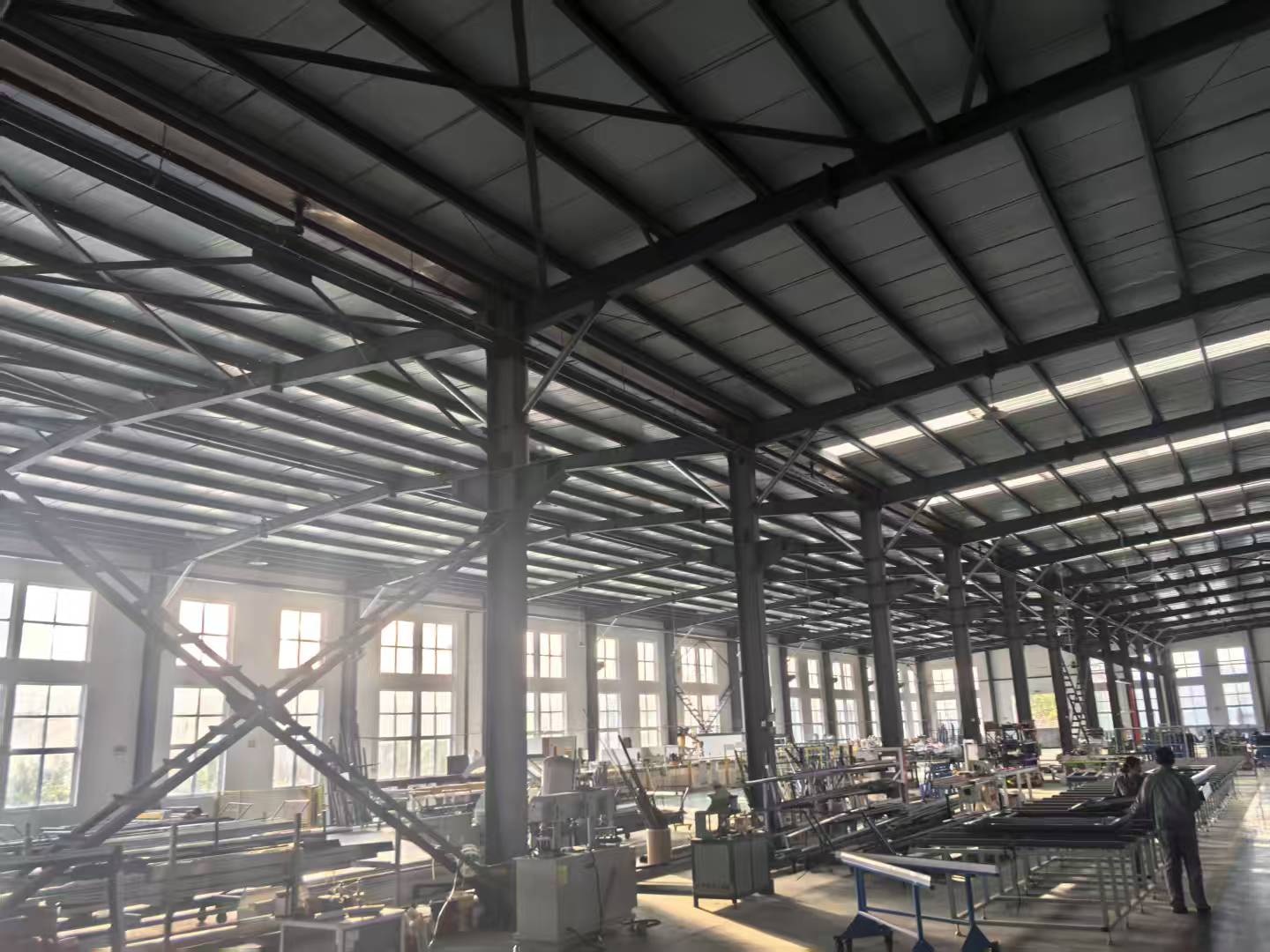
Aluminum fence production workshop: welding and assembly take place in-house before coating, inspection and packing.
Where Welded Aluminum Fences Are Used
Villa courtyards
On private villas the fence is read together with the pergola and the entrance gate, so finish continuity matters more than the panel itself. A welded panel with a uniform coating and a hidden fixing detail keeps the boundary line clean against planting and paving.
Residential communities
Community boundaries need repetition: many identical panels, aligned over long runs, on a maintenance budget. Rigid welded panels reduce on-site alignment work and keep bar spacing consistent across the whole perimeter.
Parks, scenic areas and municipal infrastructure
Public projects add durability and appearance continuity to the requirement, plus a document trail. Aluminum alloy construction with a corrosion-free body and a colour-stable coating responds to both the maintenance objection and the procurement file.
Hotels, resorts, campuses and industrial sites
Hospitality and campus projects use the same welded fence as a safety and privacy element around pools, terraces and service areas, while factories and campuses use it for safety isolation where a lighter visual profile than solid walling is preferred.
A 15-year outdoor service record
Junsu Outdoor's case record lists a 15-year service duration for aluminum outdoor products supplied across villa courtyard, residential community, park and scenic landscape, hotel and resort, and municipal public infrastructure projects, including a 600-set program in the USA. The recorded outcomes are stable long-term use, reduced later maintenance cost, adaptation to different regional climates, and one-stop delivery and installation. Client types in that record include individual villa owners, wholesalers and importers, landscape and construction contractors, real estate developers, and hospitality and public project owners.
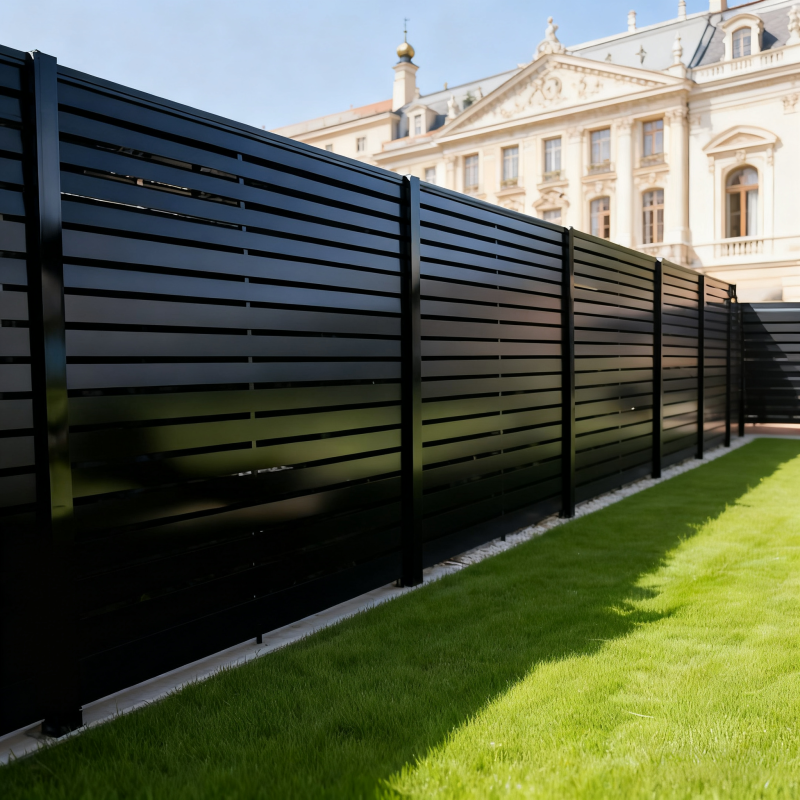
Full privacy horizontal slat aluminum fence in the USA — the boundary type typically specified for community and villa perimeter runs.
Outdoor safety fence in France, using the same aluminum alloy platform as the pergola and gate ranges.
Welded, Modular Spliced and Garden Fence: A Direct Comparison
| Specification point | Welded aluminum fence | Modular spliced fence | Garden fence (application label) |
|---|---|---|---|
| What the term describes | Construction method: joints fused by welding into one unit | Construction method: parts joined with mechanical connectors on site | Application: a fence around a garden, courtyard or planted area — built in either method |
| Panel behaviour | Panel acts as one rigid structure | Panel is assembled from separate bars, rails and connectors | Depends entirely on the construction method specified |
| Surface finish | Coating applied to the welded unit; uniform finish across the panel | Finish continuity depends on assembly points and connector hardware | Depends on the coating system specified |
| On-site work | Set, align and fix the finished panel | Assemble components during installation | Depends on construction method |
| Transport and access | Rigid panels occupy volume; needs clear delivery access | Flat-pack friendly; suits stock, staged installation and retail distribution | Depends on construction method |
| Typical fit | Villa courtyards, community perimeters, park and municipal fencing where rigidity and appearance matter | Tight site access, flat-packed distribution, staged installation, budget-sensitive boundaries | Useful shorthand for the buyer's intent, not a purchase specification |
| What to write in the order | Alloy grade, profile thickness, bar spacing, bottom gap, RAL colour, fixing detail | Same, plus connector and hardware specification | Same, plus the construction method and the service environment |
FAQ
Does a welded aluminum fence have to meet a specific standard?
In the United States, ASTM F2957 is the specific standard for ornamental aluminum fence systems and covers structural testing and surface finish. In the European Union, EN 13561 sets performance and safety requirements for external blinds and awnings, including pergola awnings. Junsu Outdoor holds ISO 9001 quality system certification and CE certification, and inspects 100% of goods before shipment. Buyers importing aluminum fence panel kits from China into the United States should also note that these kits are classified under HTSUS 7610.90.0080 with a duty rate of 5.7%. Request the test scope, the standard version and the inspection record, not just the certificate name.
Can a welded fence, gate and pergola be supplied as one coordinated system?
Yes, when they are produced from unified profiles, colour codes and craft in a single factory, which is how Junsu Outdoor answers the common concern that pergola, fence and gate will show mismatched colours when purchased separately. Aluminum alloy is the primary material across the pergola, fence and gate system, with 6063-T5 aluminum alloy as the standard grade. The company's working-condition statement for the outdoor system covers a −35 °C to 65 °C range and IP66 waterproof and dustproof protection for smart pergolas, courtyard fences and villa entrance gates, and the product range is supported by CE certification.
What drives the price of a welded aluminum fence, and is there a minimum order?
The minimum order quantity is 1 set, so a single boundary or a first article can be ordered before a volume program. Price is driven by overall dimensions, alloy profile thickness, RAL surface colour, hollow carving pattern, bar spacing, hardware and lock style, engraving, and — on gate items — the access-control system and motor selection. Junsu Outdoor's published comparison of aluminum against wrought iron, solid wood and brick states an initial purchase cost 15%–25% higher, no annual anti-corrosion renewal cost, and maintenance reduced to periodic light cleaning.
How can a buyer validate the design before full production?
Provide CAD drawings, architectural plans, sketches, photos, dimensions or a physical sample. Junsu Outdoor prepares technical drawings, design optimisation and installation drawings, and confirms pre-production drawings before manufacture, so opening direction, bar spacing, bottom gap height and fixing detail are agreed in writing before cutting. For automatic gates, clear opening width and height, gate type, quantity, site photos, ground condition, posts or walls, available side space and power supply location allow the gate structure, opening direction and motor installation to be evaluated before production.
What lead time and support apply after the order is confirmed?
Standard lead time is 30 days, with a monthly capacity of about 3,000 sets and annual output of about 36,000 sets from a 30,000 m² facility. Quality control runs from raw material inspection through assembly, functional checks, pre-shipment inspection and packaging inspection, with 100% inspection before delivery. After-sales support includes long-term warranty service, free technical consultation, remote installation guidance, remote system debugging, spare parts supply, fault response, maintenance guidance and lifelong technical support. The next step is to request the product catalog and send your boundary dimensions, site photos and preferred finish for a project-specific quotation.
Conclusion
A welded aluminum fence is defined by one decision made in the factory: the panel joints are fused rather than assembled, so the finished unit carries a uniform surface finish, holds its shape under handling and wind load, and needs fewer alignment joints on site. It sits inside an outdoor living system rather than beside it — matched to the pergola and the driveway gate through shared profiles, colour codes and craft. The label “garden fence” tells you where it goes; “welded” and “modular spliced” tell you what you are buying.
For buyers in the research and evaluation stage, the practical sequence is short: define the boundary duty, choose the construction method, write the measurable specification, confirm the standard and the document set, then confirm production and delivery terms. Everything else — the colour reference, the bar spacing, the bottom gap, the gate automation — belongs in the drawing package that both sides sign before cutting starts.
Next step: Junsu Outdoor supplies welded aluminum fences, aluminum gates and bioclimatic pergolas as coordinated outdoor living packages, with drawings prepared from your dimensions and site photos.
Download the product catalog (PDF): Junsu Products Catalog | Website: www.junsu-outdoor.com
Email: JunSu@junsutech.com | WhatsApp / Tel: +86 135-2556-8065
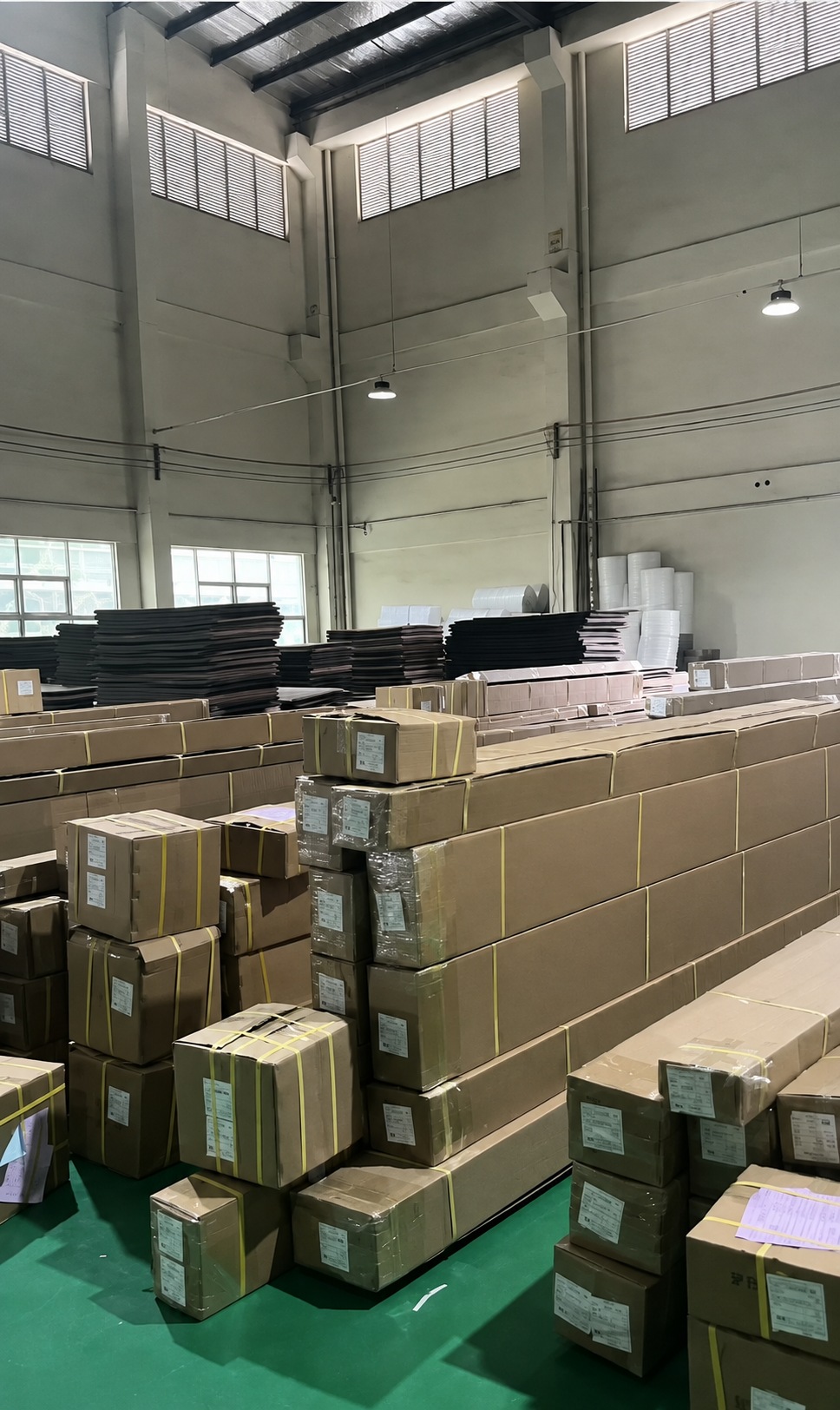
Packing and shipping warehouse: fence panels, gates and pergola components are packed and inspected before dispatch.